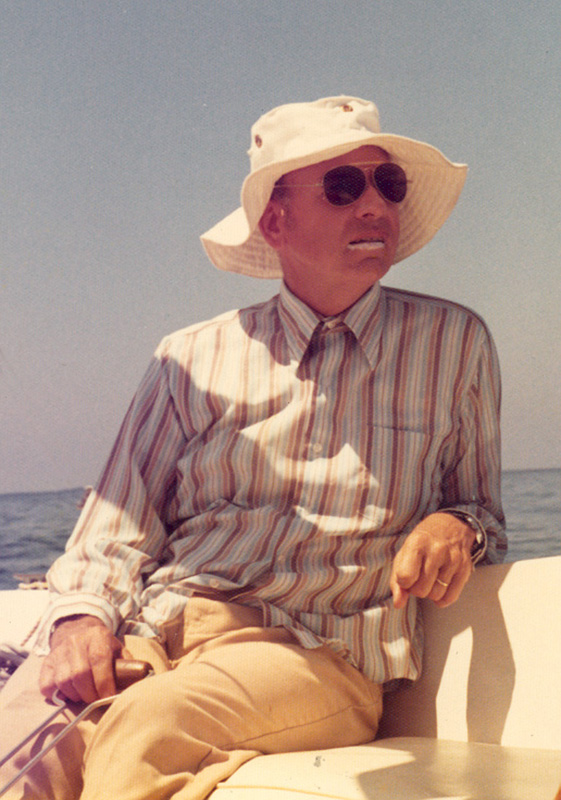
Born in Trenton, NJ
The town of Stockton is just north of Trenton, where Marilyn and I were born. I on the morning of January 5th, 1921. Marilyn on the September 25, 1922. For some reason I think I remember going down the stairs in this old Stockton house when we were getting ready to move to Gillette. Maybe it was from seeing some old photos. I know this was the start of their chicken raising business. I guess the reason that they decided to move to Gillette was to get closer to the Newark, New York markets and the Gillette house and land were better suited for raising chickens. Gillette, New Jersey was a small town of no more than 75 people on a main road that went north to Newark and towards Trenton to the south. The next town to the south of Gillette was Stirling and I went to school there until my family left for California in 1928. Towns north and east towards Newark were first, Berkeley Hts, New Providence and then Summit which was the largest town near to Gillette.
I remember the Gillette house as a large two story frame house with a full basement which was full of chicken incubators and a huge coal furnace and coal bin for hot water and steam heat. The third floor attic was large enough for living area rooms. Mother's (Nettie's father and mother Adams) came from Massachusetts to live with Nettie and Ewald about 1926 while their combined restaurant and home was being built on the front edge of the Gillette property facing onto the main north-south highway. When we moved to California in 1928 they put log rollers under the restaurant and moved it to the farm just south.This farm belonged to the Rystead's. After the restaurant was finished and the Adams had moved into it, I remember grandma Adams making me bread, butter and mustard sandwiches for afternoon snacks. I also remember taking used pop bottles that were in the wooden cases under the restaurant, waiting to be picked up by the soda-pop distributor, I collected the orange pop that was left in the "used" bottles for enough to get a free drink. Gross huh! I remember that my dad didn't like grandpa and grandma Adams. My mother got a lot of "static" from Ewald about her folks living with us and their building of the restaurant on his property.
Looking back now, I think times were kind of rough for the Adams financially at this time even though this was suppose to be the good times before the Depression (1929). When I was living in Gillette the front lawn in front of the Gillette house seemed enormous to me then (I was probably about four foot tall) but revisiting in 1984 as an adult it didn't seem near as large. My dad who had been totally blinded at the age of 19 in WWI in France by a explosion just in front of his machine gun position. He said it could have been either a German or an American shell exploding in front of a two man position. When he was back in the States, he and other blinded veterans entered the Evergreen Hospital near Baltimore, Maryland, the training center for war blinded conducted under the auspices of the Veterans Bureau. He completed a course in poultry husbandry. During this schooling, all of the blinded students were presented with gold braille watches by Queen Wilhimena of the Netherlands. I think my mother, Nettie Adams was a secretary or an assistant to a Professor Graham who taught some of the poultry classes. Somehow they met and were married in 1919/1920.
I was born Jan 5, 1921 and Marilyn, my sister was born in Sept 25, 1922. My Gillette bed room was on the second floor on the SW corner of the house. I remember the creaking and popping steam radiator in my bedroom. The folks place was about 5 acres in a pie shape piece of land with the wide part on the highway and the back edge or point ended on a swamp. On the far side of the swamp was a railroad track. The rail traffic was fairly heavy as I remember - lots of trains passing night and day. It was quite soggy near the swamp and I can only remember being there once and that was in the winter when it was frozen over. Marilyn, an older neighbor boy and I were starting to walk on the swamp ice when we heard this noise under our feet that sounded like a train passing under the ice. The older neighbor boy knew it was the ice cracking so we rapidly removed ourselves.
Near our home there were a lot of small hills so we were able to use our sleds to slide down these slopes. For summer there was a large tree to the south side of the house and the folks has tied at car tire with a rope to a branch and this was our swing. We could sit inside the tire or climb up on top to swing. In front of our house was a large sign with a red arrow on it. The arrow had a bar across the middle. This was the emblem of Ewald's 32'nd infantry division when he went to France and the folks used this emblem for their business trade mark. They sold poultry only from the house. This amounted to about seven hundred chickens in the spring at an average of more than a dollar a piece. Also an average of ten to fifteen dozen eggs, probably for a week, were sold at thedoor. They could have sold more. The first year in Gillette they made $1500 clear.
They raised only Rhode Island Reds,having about 500 chickens at any given time. The hatching was done down in the basement and there were at least 4 big (5'x5') incubators for hatching chickens. Ewald would turn these eggs daily by hand for the 21 days of incubation. In back of the house, to the west there was one large chicken house with three rooms and a garage for the folks car. There were also at least 3 individual chicken or brooder houses back of this main chicken house. They were about 12 feetsquare and were on wooden runners and could be moved to different locations. These chicken houses (brooder houses) all had to be heated in the winter, especially when there were small chicks. Coal stoves were used for heating in the winter. Dad could take care of these coal stoves, knowing when he had shaken all the ashes from the fire by passing hishand over the ash pan and judging from the heat in it whether he has reached the live coals. Also he counted the larger chickens every few nights more skillfully than a sighted person. He accomplishes this by waiting until the chickens had gone to roost and then running his hands over them. His delicate sense of touch told him how many birds there were without shoving each one off the perch. The birds remain quite undisturbed during this process. The folks sold both live and dressed chickens and fresh eggs. I saw egg buyers from Newark testing the eggs by knocking a small hole in the end of an egg and drinking/eating it raw. Maybe that's why to this day I don't eat egg whites (I do like yolks if they're hard cooked).
Thinking back now I realize how much work this chicken business must have been for my mother with a blind husband. But Ewald was busy with his chores, feeding and carrying for the chickens. He could catch and kill the chickens and pluck the feathers. This involved dipping the killed chicken into a pail of boiling hot water for about a minute then into a cold bucket to stop the cooking. Then he would pluck the feathers.
Also he could get around the house as if he could see and he always knew what Marilyn and I were up to. One thing we soon learned was not to leave doors and cupboards partly open. He was well able to cope with his blindness and had little sympathy for other blind persons who complained about their problems. Mother was always his eyes and treated him like a king. She did all the book keeping for the chicken business and continued the book keeping in California with their "second mortgage" business. My mother was the greatest cook. We ate a variety of tasty things. Hearing from the folks friends in later years, I think she would qualify as a gourmet cook.
We had a little stream south of the house and she use to pick watercress there. Also I remember crocks in the basement with raisins and dandelion blossoms floating on top. This was during the time that dandelion blossoms were plentiful. This became "prohibition" dandelion wine. They also made Hires extract root beer. There were not any bad times financially for our family. We grew-up in our early years in this rural setting. This period was just before the "Depression" and stock market collapse of 1929. Our only accident was probably during the summer of1927. I was playing with kids across the highway from our house. We were running back and forth across the road. Marilyn, 5 years old was chasing after us and crossing the road too. There was a downhill slope and a curve in the road approaching our house from the north that made it hard for drivers to see ahead. On one of her trips back and forth she was hit by a car. Luckily she only got a broken leg (could have been arm). Anyway she was wearing a cast for a while. My worst time was that I had to go to the hospital to have my tonsils and adenoids out.
We had a big Airedale named "Rusty" and sadly he was hit by a car on one of his night forages during 1927. I went to school from kindergarten to second grade riding the bus south to Sterling. I remember working with small numbered squares learning to count in kindergarten. I remember; Note:I was 5 years old, doing these number exercises with a "cute" girl in this class. We had a 1925\1926 Dodge touring sedan with side curtains. My mother was an excellent driver and we went on many one day trips. They had some good friends in New Brunswick, N.J., Frank and Rose Shammy. He was a blinded war Vet also and had a massage business there. When they visited us in Gillette and later in California, Rose did a lot of the cooking. The Shammys were from Lebanon and we had wonderful tasting things like grape leaves stuffed with lamb and rice and all kinds of zucchini dishes. Another blind friend of my folks that I'll never forget was Henry Bitters. He was totally blinded in WWI and had lost both hands mid-way between his elbows and hands. The Bitters visited the folks periodically and even a couple of times in California. Ewald's WWI machine gun partner lived in Upper Sandusky, Ohio and they visited occasionally. I think their name was O'Connell. While we lived in New Jersey, our family took a train trip to Whitewater, Wisconsin to visit Dad's family, Herman and Anna Wegner. Grandpa Herman was born in Northern Germany in 1850 and emigrated to Wisconson as a young man. I remember they lived in a home in the town of Whitewater. I went with Grandpa Herman Wegner out to their out of town farm to help him plant pieces of potatoes. I remember that each piece must have at least one eye and this had to be planted eyes up. Ewald's brothers Alvin, Oscar, Earl, others ? plus sister Guertrude and her husband Irving Huth all lived near by. Ewald was born in Jamestown?, but later moved to Whitewater where he went to High School. The damp and cold winters of New Jersey didn't agree with my dad who was also mustard gassed in WWI.
He continually caught colds and the flu. The doctor told him that he should move to dryer and warmer weather in Arizona or California. They put the house and business up for sale in 1928. I think they got about $30,000 for every thing. At the time they thought this was a monetary loss for them, but it turned out to be a financial break as they sold just before property and everything else dropped in value due to the 1929 stock market crash. We left Gillette near the end of my second grade year (early summer) with mother driving their Willys Knight sedan and headed for Anaheim, California. We stopped at White water to see Grandpa and Grandma Wegner. This was to be the last time I saw any of my Grandparents.
On to California
California I don't remember very much about the trip to California. To a seven year old it probably seemed long and the deserts of the west were boring and little to see (I thought then). In those days motorists drove across the deserts in the summer at night when it was cooler. The Willys Knight had a long icebox strapped to the left running board. It was low enough that the door would open above it. It was iced up to keep food and we ate some of our meals along the road. We entered California, probably at Needles and crossed the great Mojave Desert. Thru San Bernardino, Riverside, Corona and south through the winding old Santa Ana Canyon road. At the south end of the canyon there was a "Y" which is still there on the north side of Olive. It did the same thing as now where the "91" curves west towards Anaheim or you can go south on "55" to Orange. The folks had heard from some one about Anaheim and planned to take a look at that town for a place to live. However mother missed the right fork and went straight south thru Olive on down the present Orange-Olive Road and ended up at the plaza in downtown Orange.
This little town looked good to the folks and they decided this was the right place. It didn't make any difference where they settled. They stopped at a Realtor who had an office in the Orange plaza and rented a two story house on the west side of South Glassell between Palmyra and Culver streets. The house is still there and presently (1996) is still a home. Most of the other houses are now business offices.
Orange Public Grammer School, 1929-1935
In the South Glassell Street house, I had the front upstairs room for my bedroom. The Lennert family lived next door to the north. Their house was the corner of Culver and South Glassell. They had a son and daughter a little older than Marilyn and I. During summer the folks were out looking with a real estate man named Mr Swazye for a home to buy in Orange. By August 1928 the folks found and bought a red tile roof, cream stucco three bedroom house on a city lot (50 feet byabout 200 feet) at 143 S Waverly, Orange, California. In 1928 the 100 south block of Waverly was all there was of South Waverly. A carpenter, Mr Ben Larmer lived directly across the street from us and he had built our house. He was in the process of building a third house just south of his house and across the street from our house.
Al and Betty Eisenbraum would buy this house. Al Eisenbraum worked in the Orange Tin Shop on North Orange Street. He was a very talented artisan and every Christmas he would bring over a present he had made. I remember a little miniature copper wash tub to be used as an ash tray. One Christmas he had painted a picture of the folk's Waverly Street house and gave it to them. I still have the picture at my home. On our side of Waverly street there was an Valencia orange orchard that extended south from West Chapman around our house farther south to the end of the 100 Wavery block at Almond street. There were some large English walnut trees on the south end of this orchard. For a number of years I had this orange orchard to play in and every time they would irrigate, I would have all these plowed ditch rivers of irrigation water to boat in, much to the consternation of Ben Larmer's brother? Larmer who took care of this orchard and who, I think owned it.
The house north of the folks house was owned by the Halmans. It faced north on East Chapman Street. There was a empty lot (filled with orange trees) between Halmans, west toward Waverly street. The back end of the Halman lot was the north side boundary of the rear half of our lot. On the back of Halmans lot was a huge two story barn. It had been a stable at one time and had a huge hay loft up stairs. We soon found how to sneak into this barn. Also I use to climb up the back side of the roof to a small cupola that was built on the top ridge of the barn. I nailed slats on to theshingles for climbing up the steep roof to the top. I don't think the Halmans ever said anything or maybe didn't even know about us playing in this building. It was well built and after my folks had moved from Waverly Street, this barn was refurbished inside to a fine two story up-scale home. In September 1928, I started third grade at Maple Street primary school with Marilyn in the second grade. This school was just two and half blocks north on the corner of Waverly and Maple Street.
When we first moved onto Waverly Street, they did not deliver mail to our house, so we put a our mail a half a block north on the corner of Chapman and Waverly. Dad use to walk with his cane up to the mail box and get the mail every day. Later it was delivered thru a mail drop in our front door. At the south end of Waverly and on the cross street, Almond Street, Charles Williams lived. He was also in third grade but was a year older. He had been held back a class some time before we moved to Orange. His father was a steam engineer at the Orange Water Works plant on Water Street which is one block east of 100 block of South Waverly. With Charles, I would get to visit this pumping plant with it's two huge steam engines and one large natural gas engine. They were used for pumping Orange's city water. The city's water tanks on huge towers were also here. I remember the enormous fly wheels that these single cylinder monsters drove. Charles was my best friend up thru the mid-1930's. Next door to Charles and to the east another, no relation William's family lived. Bernice Williams, who was in my grade, a 2 year younger brother, Jerry and a year or 2 older brother Billy. Jerry was killed in a jeep accident during WWII.
I've seen Bernice during the late 1980's at a school reunion. A couple of my other friends were Eugene Crane who lived om South Cambridge. His father was a clerk at the Orange Post Office and after the war (WWII) Eugene also went to work for the Orange Post Office. John Pannell, a year younger lived straight west of our house on Cambridge street. We had lots of vacant lots and orange orchards to play in. The vacant lots would have waist high grass and wild oats during the spring and summer and we could make paths and secret rooms thru the grass. We did lots of kite flying in the open fields. Another past time was digging under ground tunnels and rooms. We didn't actually dig tunnels but dug trenches and then used boards to cover them and heaped dirt on top of the boards. Every so often my folks would decide we were through using them and all the trash, etc. would be used to fill them in. We always had lots of projects and things to build. We use to go to the library and get books on things we could construct ourselves. At one time Charles and I had our private telephone wire strung along the telephone poles for the half a block between our homes. During the thirties, which was depression times we would go down along the Santiago Creek bed to where South Lemon Street and the Railroad and the Orange-Santa Ana street car tracks crossed the creek. The depression "Tramps" lived there and they all had crystal set radios. We would copy their circuitry for building one for ourselves. These sets need a long antenna and mine was always from a pole outside my bedroom window to the top of Holmans barn. I remember we could pick up radio stations KFI and KFOX. We built tree houses 30 to 50 feet above the ground and never had an accident hauling up these heavy boards to build a platform on the cross branches high above the surrounding houses.
Our favorite afternoon on Saturday was to hike the half mile south along Cambridge Street to the Santiago creek bed. On the way along South Cambridge there was a alley way that had purple grapes free for the eating. The creek in those times always had a little water running down it and there were the occasional pools where we could catch crawdads and minnows. Make rafts and even swim. It was shallow and I didn't learn to swim until I was in high school (a later story). In the these years we had a Ice Box and a built-in cupboard in the kitchen with vents thru to under the house and vented to the roof. This was called a cooler. This is what we had to keep our perishable food. There were quite a few daily delivery truck businesses in those days. Mother had a cardboard card with numbers like 10, 20, 30, 40, which was placed in a street side window with the number on top for the size of ice block we wanted for our ice box. Also there were Webber's Bakery and other bake goods and vegetable trucks, the milk man and in summer we had the ice cream wagon. When the folks moved into Waverly Street, the back yard became a farm that is around the edges. We had a big back lawn with a swing and a cement patio behind the garage. There was one full grown orange tree left in the front yard from the orange orchard that our house was built in. In the back yard was a large avocado tree that had some how been planted early on in this Orange orchard. After the folks moved into this house they planted a couple more orange trees, a English walnut, persimmon, fig, lemon, another avocado, grapefruit and a pomegranate. At the rear of the lot they put a chicken pen and run. Behind the chickens was mother's garden. I used to earn my allowance digging up the Bermuda grass/weeds to make more garden. Every spring mother would plant a chiote vine that would grow up the rear side of the garage and cover the whole top of this flat roofed garage. We would have fried chiotes, baked chiotes and probably other ways. Also all the neighbors and friends would be well supplied with chiotes.
Mother buried all of the kitchen garbage in our yard. That was my job to dig a hole to put the garbage in and sprinkle a little lime on top and cover the hole. I'd leave the shovel next to the last hole to mark my next diggings. With this and the droppings from the chickens she had wonderful soil for growing her plants and vegetables. Later they bought a 20 foot strip of land along the rear edge of their lot from Mr Bills, the farmer behind us and the garden became larger. They added a barbecue grill to the patio behind the garage. I remember the good T-bone steaks that were cooked there. They had Ben Larmer built a screen house in the back yard and mother and dad spent a lot of time in it. I remember mother often reading stories out of the Saturday Evening Post, Colliers, Country Gentlemen, and others books and magazines to Ewald and often with Marilyn and I listening too. These readings went on all during my life at home. Two blocks east of Waverly Street on Chapman Ave. towards the Plaza was Pine Street. On the corner was the Immanual Lutheran Church. This was a break-away church from the Saint Johns Lutheran church on Shaffer Street. I learned only last month (January 1996) from Mark's mother-in-law Velma Patterson that the break-away happen after the married Pastor Rev. Jensen - had an affair with the wife of Mr Ehlen of the Ehlen and Groete Groceries on South Glassell St in Orange. Some of the parishioners were unhappy that Rev. Jensen would not bow out of the pulpit so they left and a new Lutheran church was formed. After we moved in, Reverend Weberking of the new Lutheran Church called on my folks. That resulted in Marilyn and I enrolling in the Sunday school classes. Mother would go to church and dad would occasionally have a beer or a glass of wine at our house with Rev. Weberking. He never went to church. I don't think he even went when Marilyn and I and the rest of the Sunday School membership had to recite at the yearly Christmas programs.
I remember once getting caught eating penny candy in Sunday School class. When the collection plate came around during Sunday School it seemed that I had lost my nickel earlier for the Sunday collection. Folks were informed of my loss. At this Sunday school class I met a George Heuck. He became one of my best friends during the mid-thirties. His father worked at San Pedro harbor as a Coast Guard Quarantine Inspector. He was a doctor. In this capacity George's father would meet the incoming ships for health inspections. Several times George and I got to ride out on the tug boat to meet these large ships with his father. George was one grade ahead of me, but we were about the same size and seems that we were forever wrestling in his or my backyard. At this time my folks thought and probably rightly so, that bicycles were too dangerous and never bought me one even though all my friends had their own, including George. I use to ride his home to my house occasionally so my folks relented and I soon had my own. I soon learned how to disassemble every thing on it, grease the parts and reassemble them including the "new- departure coaster brakes.
With wheels, our area expanded, south to the north edge of Santa Ana, west to the Santa Ana River, North to Olive and east to Lemon Heights and once to Orange County Park (later named Irvine Park). George, probable due to his father job, was interested in boats and started building a kayak. This is when I started building small boat models. My first one was from plans out of the Popular Mechanics magazine. In the thirties they use to publish scale model boat plans periodically. My first one was the "heavy cruiser Pensacola". I still have this model. The actual ship was sunk in a Pacific WWII battle. George had an eye put out by a BB gun prior to me meeting him. Because of this he was declared 4F for the draft. I lost track of him after I enlisted in 1942. I heard he "over did it" with drinking and wild driving. He killed himself in an auto accident in the early forties.
The family took a trip to Port Townsend. Washington to visit dad's cousin Clarence Wegner and his wife Eleanor. Clarence was a Chief Warrant Officer in the Army, Coast Artillery, based at Fort Townsend. Mother drove the Willys Knight. While we were there we got to go "gooey duck" clamming on the Puget Sound and at Fort Townsend I got to stand behind a big 12" artillery cannon when they were target practicing. I remember that when they fired the shell it was so big you could see it going towards the targets, some 6-7 miles out in Puget Sound. Clarence and Eleanor had 10 or 12 children so Marilyn and I had plenty of playmates while we were there. The folks occasionally took several trips without Marilyn and me. When this happened, the neighbors across the street, the Larmers would take care of us.
Some Friends of my folks:
Will and Rose Alexander- Blind vetran living Fullerton Bert and Myrtle Randell Blind Vet living in Pomona Frank and Rose Shammey Blind Vet living Baltimore,MD My Friends William Burchell - High School Donald Krueger - High School Forest Oakles - Gammer and High School Richard Webster - High School and Jr College Eugene Crane - Grade school thru High school Charles Williams - Grade school thru High School
Balboa Island
My folks supplemented Ewald's government disability pay by making small $2000 to $4000 short term loans on houses and property. I still have some of Nettie's books on these loans. With these two incomes and being frugal they did well financially during these depression early 30's years. About 1935 (?) they bought a beach house on Balboa Island for $1800. It faces on the water. ie: the "Grand Canal". We would leave 143 S Waverly Street every Friday afternoon or Saturday morning and go to the beach house and stay until Sunday evening. I know now that my folks buying and living week-ends in this beach house had a profound effect on the rest of my life. This was because I acquired a whole new group of friends.
The houses up and down the Grand Canal were all week-end types of homes, however a few people did lived there year around. The house to the south of ours was a one story frame with a bigger frontage, probably about 75 feet. The folks loaned the Brubaker's money to buy this place. The building adjacent and north was owned by a young bachelor named Mr Hamilton "Hamm" We gave him a terrible time and the poor guy put up uncomplaining for years with our "dumb and mean kid" antics. The Hudson and ? families had a week-end house two doors south. Mr. and Mrs. Rutters lived the year around next house south of the Brubakers. The Axline family were further to the south along the canal. Most of the families had kids Marilyn and my ages so living in Orange and then at the beach on week-ends we were in two neighborhoods. The Brubakers were Walt and Lucille and their two daughters were Marijane and Doris.
The Ross's, a family from Orange built a large house across the canal from our house and on Little Island facing North Bay. Everett Ross was a year or so younger than me. Earl and Vern Flanders of Orange had an uncle, a Mr Elson who for some reason they nick-named "clothespin". This Uncle owned a nice beach home on North Bay. Everett, Vern, Earl and I became our Orange beach gang on weekends at Balboa Island. We had good times and did a lot of mischievous bad things that I'm not proud of today.
Army Air
In 1940 my sister's boyfriend, Bill Huscroft had taken a flying course through Santa Ana Junior College called Civil Pilot Training. He took me for my first plane ride. By the summer of 1940 I enrolled in a this (CPT) course at Santa Ana Junior College. Ground school courses of Aircraft, Navigation and Meteorology were completed at the college before any flying was permitted. The flight phase was flown at Eddie Martin Airport just east of Newport Boulevard where South Main Street ended on Newport Blvd. John Wayne Airport hadn't been completed at this time. We flew Piper Cub, J-3s and I soloed in 8 or 10 hours. We flew one hour flying periods during daylight hours only. We learned how to do accurate figure "S" using a road or telephone lines to judge our turns and compensate for the wind. we practiced stalls, loops, Chandels and lots of take-offs and landing. When everwe were flying with an instructor you could expect the engine to be idled back at any time to simulate an "engine out" emergency. We had to pick an emergency landing spot and set up an approach to this emergency spot.
I thought that flying my fifty hours was taking too long (and was interfering with my beach time) so I told the Instructor I wanted to quit. They didn't get any money from the Government until we students completed the course. The school arranged to let me fly more than 1 hour per flying period so I could finish sooner. I would go out and religiously practice stalls and spins for 2 or 3 hours and come down thoroughly nauseated. I always flew just how they told me to but I know other students use to come back on solo flights with tree branches and bean vines in their landing gear. I never did like buzzing. The higher the better was my rule. I got to test my navigation skills in the later part of our flying school by making cross-country flights. One trip was to Oceanside (my instructor went along to observe; probably because he was bored just flying in the local area instructing us students). We landed first at a field next to the ocean and just north of Camp Del Mar on the present day Camp Pendelton. Today (1996) the ground at this field is partially wet at high tide and but there still is the remains of a cement block Oceanside airport operations building on this field. We took off from Oceanside and flew to Corona airport then back to Santa Ana at Eddie Martin's airport. I didn't get lost.
At 50 hours flying time, I took my Flight test with a FAA government examiner and received a Civilian Private Pilots License. By 1941 a lot of Phil Campbell's orders were for pipe and ship building fixtures from the ship yards at San Pedro. The war was getting close and they were drafting us "young boys". Phil said we were doing defense work and he could keep me out of the draft. Since I knew how to fly I was thinking about joining the Army Air Corps and had been trying to talk my friends, Vern Flanders and Ed Ehman to join with me but their folks both said no. I had to fly 15 hours a year to keep my flying license active and I would talk my friends into paying half the five dollars per hour to fly. On December 7, 1941 I had got Everret Ross to go with me on this Sunday morning for a three hour flight. We flew up over our respective homes to wave at our families and then flew over Irvine lake. We had a bag of oranges which we thru out to bomb the lake.
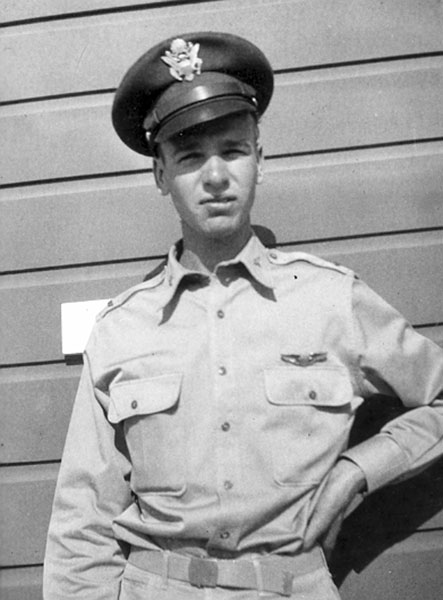 We got back to the airport about 11 AM and landed. The man who rented us the plane immediately told us that we were the last plane to be flying as all planes were grounded. He then told us about Pearl Harbor. This made up my mind about the Army and I went to Van Nyes Airport in Los Angeles to take a test for Aviation Cadet Training in the Army Air Force. I passed the test and wass ent to downtown Los Angeles enlistment center to enlist. They asked me what I wanted to do and my first choice was meteorology, I had liked this course I had taken for the CPT flying course at Santa Ana JC. They discovered that I had a civilian pilots licence said I would have to go to pilots school. I believed them and by the first week in January 1942 I was on a train to Minter Field, just north of Bakersfield for Pre-Flight Army Air Corps training. Our class was officially labeled "Class of 42-G". Minter Field was Basic flying school for army cadets flying Vultee BT-13's. They also had this indoctrination school for newly enlisted flying cadets. This was a temporary location until the Cadet center at Costa Mesa was finished. For some reason they called the new center Santa Ana Army Air Corp Pre-Flight school even though it was built in Costa Mesa where present day fair grounds are today.
At Minter Field We were issued cadet uniforms and proceeded to learn all about marching. We lived in four man tents with a wooden floor and a fuel oil stove in the middle for heat. After about a week of just getting up before daylight in the cold January mornings for roll call and marching in the mud, we started aircraft ground school and other military subjects classes.
During the last week of January 1942 we were sent to Oxnard Primary School (previously called Major Mosely Mira Lomacivilian flying school) to receive instruction in the Army's PT-13B's, Stearman aircraft built by Boeing in Wichita weighing about 2000 pounds. This was a pretty fabric covered bi-plane with a blue fuselage and yellow wings. The engine was a Lycoming R-680-17 radial 220 hp and our flying instructors were all civilians. Mine was a red-headed fellow by the name of Storge. We had some Army officers in chargeof this school and they would give the final checks and evaluations. Also when anyone was to be "washed out", one ofthe military pilots would take the student on the "decision making" flight.
Our school CO was a 1st Lt Theron Coulter. We were welcomed on our arrival from Bakersfield at the entrance of this facility by our upper classmen in dress uniforms complete with white gloves. I do remember those white gloves. That was the beginning of the constant hazzing we endured until we became upper classmen. As underclassmen we had to double time every where we went. When I became an upper classmen and could walk at a normal pace it seemed to take forever to get anywhere. The cadets lived in small bungalows that slept three under classmen in one room, a joint bathroom between another similar rooms with three upperclass men. Our upper class was mostly from New York City and by the time our class had arrived over half of them had washed out of the flying program and were waiting for an assignment to Navigator, bombardier, or armament school. Our class figured that being from New York City they probable couldn't even drive a car let alone a plane. This gave them lots of time to give us under classmen their undivided and sadistic attention. Also our flying instructors use to "ride" us on quite a few occasions too. Thinking back I know it was meant to provoke our temper, nervousness, etc. At our graduation party my instructor verified that they did this onpurpose to test our temperament and stability. Today, I think they should also use this type of testing on applicants for car driving licences today.
No fatal crashes during our tour at Oxnard, but we did have one Stearman land on top (and luckily to the rear) of the cockpit of another Stearman. Onlythe planes were hurt. We did have some of our class washed (failed) out. The Stearman had a narrow landing gear and on landing it was easy to lose control and groundloop usually touching a wind tip on the ground. All of us (me too) whonever had a ground loop were give a small bronze plaque from Major Mosley. Since I had some flying experience in Piper Cubs this course seem easy as I knew what the instructors were trying to teach us. Originally I was told that this would be a hindrance and would have to "un-learn" bad habits but this was not true. On March 24th I had 60 hours and we all had passed our Army check rides. The Class 42-G was sent to Basic flying school at Lemoore Army Air Base at Lemoore, CA. This base is about 40 miles south of Fresno and is now a Navy base. Lemoore AAB was all Army personnel and the Cadets lived in barracks with two to a room. There was a big common shower and toilet room in each barracks which we had to "GI" clean ourselves. We marched to the mess hall for meals and to all of our classes. However we had no hazzing here, just down to the real business of learning how to fly the Army planes. All of our flight instructors were Army Air Corps pilots and officers.
The flight I was in, had an instructor who also had duties as the Squadron supply officer. He often had other places to be so we (5 students) were often parceled out among the other instructors in our Squadron. All of the flight instructors were young Lts and it seemed I spent most of my instruction flying when I was with the substitute instructors flying at about five feet above the ground over the fields and fences of the country side around Lemoore. It's a wonder I was able to pass my flight exams. We flew Vultee B-13s here. It was a low wing all metal fuselage and wings. The landing gear was fixed and it had a radial R-985-AN-1 engine of about 400 hp. It looked (to us) like a real fighter plane. It was a more exacting and less forgiving plane than the primary Stearman. It had a bad stall characteristic in that it would do a half of a snap roll when it stalled out. We lost two of our classmates when they let their air speed get too low turning onto final approach which was around 800 ft altitude; too low an altitude to recover from a inverted position. Our flying periods were three hours and we now flew both nights and days and had cross-country navigation flights that took us over most of the San Joaquin valley.
I had my first in flight emergency here. I had just taken off on a solo afternoon flight when my cockpit started to fill up with smoke. I opened the canopy and radioed the control tower of my problem and was coming back to land. I landed hot and long and I think I actually went off the end of the far end of the runway a little. Didn't hurt the plane and I turned off the switches and got out. It turned out that the engine starter switch had stuck in the on position and its associated wiring had caught on fire. At the end of our Basic schooling we were given some choice to go to single engine school and presumable to fighters or to multi-engine school and into bombers. If you were short or tall then the Army made the choice. Single engine school was at Luke AB, Arizona and multi-engine was at Victorville, California. I had always wanted multi-engines, the more engines the better. By 22 of May 1942 I had a total of 137:35 hours and was sent to Twin-Engine advanced school at Victorville, CA. to fly AT-9s. This Base also had a bombardiers school flying C-45s. The source of bombardiers were "washed outs" from pilot training. We learned to fly AT-17's also.
The AT-9 was a much "hotter"and more modern airplane to fly. It had two constant speed radial engines of about 250 hp each. Also they were non-feathering so if you lost a engine you had to make a slow descent to maintain your air speed. Now we flew with two cadets or instructor and cadet in side by side seating. Take-off was at 110 mph and cruised at 145-150 mph and landed at120 mph. The AT-17 was like a twin engine Stearman. Our flight instructor checked me out in the AT-17 with one ride around the field and a landing. we used the AT-17s for instrument practice only. I checked one or two of the other cadets out in the AT-17. We lost two students from our class when the wing broke of a AT-17. We were told that they were trying to do a loop or some other acrobatics in this plane. We lost two other students on a night take-off crash.
Our flying area was essentially the Mohave desert out to the east as far as Las Vegas. We weren't allowed to go west beyond the Cajon Pass. In the AT-9's we learned to fly formation both day and night. I remember how the Instructor who was in one of the 3 plane flights, radioed us to move out and not fly too close. I don't blame him. We had quite a few cross country flights out as far as the Colorado River and on to Las Vegas. On weekend passes we could now wear our officers pinks. We were close to becoming lieutenants. On the 19th of July I had 200 total flying hours and all the cadets with 200 hours were to be graduated as 2nd Lts and sent on our way to our next assignment. We were immediately restricted to the base. My folks drove to Victorville for my graduation and to say good-bye.
90th Bomber Squadron
July 20 1942 - By this date I had accumulated 200 hours Cadet flying time in PT-17 Stearmans, BT-13 Vultees and AT-9 Curtus trainers and was commissioned a 2nd Lt in US Army Air Corps at Victorville, Ca. As the aviation cadets reached 200 total flying hours they were immediately graduated as 2nd Lts. Thus our class 42-G had different dates of rank. We were restricted to the base at Victorville, but my mother and father were able to drive to Victorville for my commissioning and see me receive my silver wings. Next day 32 members of my class mates, including myself were on our way to Columbia S.C. for training as B-25 pilots.
July 29 - From the dry heat of the Mohave desert at Victorville, CA to the damp sticky summer heat of South Carolina was quite a change. I received my first flight in a B-25, an orientation flight to Myrtle Beach Army Base. This was my last flight in a B-25 until 1947. During our stay at Columbia AAB we noted that Base had designation lines on one of the runway where Doolittle's carrier take-offs were practiced for their raid on Japan. This same day some of the single officers (note: single) Lts were transferred to the newly formed 90th Bomb Group based at Greenville AAB S.C. We were assigned as B-24 co-pilots and I was placed in the 400th Squadron.
August 1 - I was assigned to Lt Melvin James Porter's crew and had my first flight in a B-24. Four engines instead of two as on the B-25's is nice. On the 7th of August we flew a 6 hour round robin cross country out of Greenville AFB.
August 9 - Our crew was transferred to the Ford Motor Company B-24 plant at Willow Run, Michigan. The reason given for our assignment was because of labor problems at plant and our "Show of a Patriotic Effort" was to "motivate" them into forgetting their labor problems and get back to work. The plant was one mile long and one-fourth mile wide. Production of Liberators at the plant began in 1942 and 6,792 of Them were built during the operation of the plant. 1500 men of our90th Bomb Group were quartered in this huge hanger in which their cots were in neat rows. I was quartered in a small building near the main plant with about ten other officers. There was no mess hall and a field kitchen was set up behind the hanger.
On the 11th of August our crew flew a evening cross country training mission.
OAugust 14 - Our Group lost a B-24 and crew due to bad weather near Detroit. The local Ann Arbor people did quite a bit to entertain the troops. I remember one evening spent with the Kaiser (automobile and ship building) family and at another time a blind date with a University of Michigan coed.
August 23 - Orders were issued for the group to move to Camp Stoneman, Pittsburg, California. We were soon packing our equipment and were on the way to Camp Stoneman. This trip was made by the support troops, and crew members not needed to ferry the group's 12 B-24s to Sacramento, California. This included most of the co-pilots. Our train was hot and very sooty. I think we were put on a siding for every train we passed. The train was made up of entirely of the 90th Bomb Group with our own cooking "mess hall" railroad car.
August 28 - We Arrived at Camp Stoneman and were processed and issued our overseas equipment. I now had my very own Colt 45 automatic and a set of binoculars. The binoculars were later taken for a Squadron pool in New Guinea and issued to individual planes as needed. Dad and Mother Wegner with Mr. and Mrs. Casto drove up from Orange for a Final visit before we shipped overseas.
September 3 - About 10 AM we boarded a train for San Francisco. There we boarded the U.S.A.T. Republic. The ship stayed at the dock all night and left about 9 AM the next morning. There was four merchant ships and two destroyers in our convoy. I was in a cabin above the water line with three other officers. Our duties aboard consisted of shifts as watch officers looking for I don't know what; subs I guess. We zigged and zagged all the way to Oahu, H.I. This passage took 6 days. According to rumor, one of the other ships in our convoy was full of nurses so we got to practice with our binoculars. Couldn't see a thing except water and our convoy. Near noon of the sixth day, just out of Honolulu, we had an alarm for a enemy sub nearby and the destroyers suddenly became very active, racing all around our convoy. I don't think they ever verified finding anything. We docked about 2 PM September12th next to the Aloha tower in Honolula Harbor. There we were welcomed by an US Army band playing song s of the islands and popular music of the time. We were lucky as my squadron (400th) and the 90th Group Hdqs were assigned to Hickam Army Base, next door to Pearl Harbor. The other three Squadrons,321st Sq was assigned to Wheeler Field adjacent to Schofield Barracks; The 319th SQ was stationed on the extreme northern point of Oahu at Kahuka Point; the 320th drew the short straw and settled in Kipapa Gulch in the former quarters of the workers of a sugar cane plantation about 4 miles south of Wheeler Field The Air crews were to depart on the 15th of September for Hawaii. We were to be here for a month, flying long patrol or search missions of about 11 hours duration.
Our first mission was on the 22 Sept for a 11:45 hour search mission. We now were a crew which we would keep together until we returned in 1943. (Bill Sullivan says he didn't join our crew until we were at Iron Range, Australia. Lt Conti was our navigator and later in Australia he become 90th Bomb Group navigator. That's when we acquired Bill Sullivan.
September 26 - I had my first transition training and made 3 landings and take- offs at Wheeler field. In my log book I described them as poor. But this was the first time to try so maybe better next time!
September 26 thru 26 October - We flew 10 missions including three search missions to the west of Oahu. The other missions were for practice bombing and gunnery in formation. For the practice bombing the Navy towed a target raft behind a destroyer. I remember that one of these mission someone (not us) put a practice bomb on the back of the Navy tow ship. At this point I'd like to tell how Hickam and Honolulu looked to me. The Air Base at Hickam still had scars left from the Japanese attack on December 7, 19 41. There were still wrecked, broken and burnt Martin B-3 bombers, B-17's and P-40s on the field. At least 3 hangers were collapsed from bombings and the main mess hall on the base still had signs of blood on the walls when they were hit that Dec. morning. They told us that there were heavy casualties here. The Army had moved all of the families back to the states by this time and five 2nd Lts where put into one of the family base houses. Our group was Lts Dunbar, Dunmore, and Tom Fetter-all Bombardiers, Lt Lewis, 400th transportation officer and a copilot - Me. Off duty we stuck pretty much together, going to Honolulu, etc. We were here until the end of October flying about every third day. Our Squadron was assigned a Piper Cub (L-4A) and I see from my Form 5 that I had 6 flights in it during October. Lt Sarkesian nosed the plane over and broke the propeller. The L-4A 1st pilots became full time co-pilots again.
October 31 - 1942 We left Hickam for Australia. The planes were equiped with bomb bay tanks for the trip and loaded with as much equipment for plane maintenance as possible. We also had some of the ground crews with us as the group would be on their own until the surface escheon arrived. This is the first B-24 group to be assigned to the South West Pacific Area (SWPA). Our B-24 is "Yardbird", # 905. Our first leg of 7:45 hours was to a little group of atolls named Christmas Islands, claimed by both the Americans and British. Their were a few P-39's based here. The next day on the 1stNovember we flew 6:35 hours to Canton Island, a bleak white coral place. We next cross the date line to Nandi, New Caledonia; a 7:30 hour flight, but because of the date line we have lost a day and we land at Nandi on the 3rd October. We only refuel here. I remember the New Caledonia red volcanic dirt (dust) and getting it all over our khaki uniforms. Off by early afternoon and landing a few hours later at Amberly Air Base about 20 miles west of Brisbane, Australia.
November 8 - we left Brisbane for Mareeba, an air base inland from Cairns, Australia. On the 9th we made the two hour flight to our new home on the east Australian coast of the York Peninsula at an air strip called Iron Range. This last leg is our first time logged as COMBAT ZONE (CZ) flying time. Combat mission time was logged (CM). A little about Iron Range follows. The base was located about3 miles inland from the east coast of Australia on the York peninsula and consisted of two separate runways cut out of the eucalyptus jungle with very little clearance on either side of the runway. These were Claudia and Gordo strips. Our living area was within a mile of the Gordon strip and was entirely made up of tents. This included mess hall, hospital ,operations everything! The 22nd Medium Bomb Group of MartinB-26s was based at Claudia Strip. I remember talking to one of the B-26 crew members early after our arrival and they really "poured it on" about "problems" flying combat against the Japanese. I found out later that they in reality did have a lot of losses in combat from the Japanese Zeros; a lot worse than we did with the increased fire power we had on our B-24's as compared to a B-26.
Our home was a GI four man canvas tent. The tent was on a slight grade down hill and as it rained every afternoon (I mean heavy rain. We were in the monsoon season here in the tropics), we had to dig a small ditch through the dirt floor in the middle of our tent. We could not keep the water out when it rained. One thing I remember about the food was lots of canned Australian corn- beef and powdered eggs. The food that I missed most was fresh green salads. We washed and shaved out of our helmets, but I use to sneak hot water from the nearby mess hall hot water drums that were being heated early in the morning for our breakfast washing of our mess kits. Showers were COLD water. Our recreation was to take our automatics and go target practicing in the jungle. Occasionally our squadron would have a truck take us east to the beach for swimming. On the beach is where I saw my first Australian Aborigine.
November 14 - our plane # 904 "Yardbird" is lost when it landed short of the runway and into some tree stumps (I think Townsville). A crew of the 90th headquarters was flying. None hurt. Up to this point our crew always flew "our" plan eand I had left mothers Kodak bellows camera on the plane. It was lost or reappropriated. Our new ship is "Bombs to Nipon" #942 and we flew to Port Moresby for our first mission. Below is a list of our crew for a B-24C. Later we would have newer version B-24D. Later the navigator position was moved to the flight deck behind the pilot and we got a 10th crew member, a nose gunner.
• Pilot - Milton Porter
• Co-Pilot - Robert Wegner
• Navigator - William Sullivan
• Bombardier - Edward Diggs
• Engineer - Robert Tavener
• Radio Oper - Melvin Lewis
• Left Gunner - Samuel Sottolano
• Right Gunner - John Hansen
• Tail Gunner - Daniel Rozow
• Nose Gunner - Jimmy Ward (later addition) Moved the Nav station behind the pilot's seat.
While at Iron Range we used Port Moresby to stage for our missions north across the Owen Stanley mountains of New Guinea. We would fly up from Iron Range one day and have abriefing for a mission next morning. We generally flew back to Iron Range after the mission without landing at Port Moresby. At Port Moresby there were at least Five Air Fields with A-20s, B-17s, B-25s, P-38s, P-39s, C-47s, and Australian Beaforts and Beau fighter aircraft. The fighters, P-39s and P-38s were used as air cover for theC-47s that flew supplies across the Owen- Stanley mountains to the troops fighting the Japanese. The P-38s were superior inmost ways over the Zeros, however about the only advantage the P-39s had was the top speed in a dive away from the Zeros. Only problem there's usually only so much space to do this maneuver. During the period I was in the SWPA, Our group never had any fighter cover. I heard that our group had more enemy aircraft to our credit than the Port Moresby fighters. I don't think the zeros liked to mix it up with the P-38s.
December14 - We flew out of a B-17 base that Belonged to the 43rd Heavy Bomb Group. It was called Jackson Strip. This B-17 group had some of the crews of the 19th BG that made it out of the Philippines early in the war. We arrived at Five Mile strip, Port Moresby just before some of theB-17s came back from a mission. That evening in the mess hall there was a crew member from today's mission with a bandaged arm and obviously some blood spattered on his shirt. If this was to impress us new green crews, it did just that; a suggestion of what might be us tomorrow. 15 November 1942 Ship # 942 We're up before daylight. The briefing is in the mess hall and you could hardly hear the briefer telling us about the targets. We were to take off at single intervals and each aircraft had an area to search for Japanese shipping. Our assigned search area was along the west coast of Bougainville Island in the Solomon Island group, Buin-Faisi area. This was not normally our area of responsibility but the Japanese Navy was saturating the Solomons so the 90th was called in to help out. Our flight to Bougainville was uneventful, arriving late in the morning. We followed the coast north and we suddenly came upon a single funnel cargo type ship just off the coast. It wasn't even moving.
Our first encounter with the enemy. We circled the area to make a long straight run on the target. We were at fairly low altitude, probably around five thousand feet. It was to be the proverbial "down the pickle barrel" run. Bombs were away with no anti-aircraft fire and still no movement of the ship. We circled to the left to see our first Japanese ship sink. It was still there, nothing happened! Then one of our waist-gunners called on interphone saying that he thinks he saw our bombs (all of them) explode about 2 miles away from the ship. Well so much for accuracy down a pickle barrel. What happen was; often on the beginning of the bomb run the bombardier "sets" his bombsight forward on what is called extended vision to get a early fix on the target. When he takes over the aircraft on autopilot for the final run, he has to set his Norden bombsight back on normal position vision. This he forgot to do and this setting of the bomb sight released the bombs early. So these Japanese sailors will live another day and we've done nothing for The war effort. At least our plane and our crew is still in one piece. We land back at Iron Range after 9 hours and 10minutes. On the return trip our crew decided to take a "tourist" look at the war and see how the army is doing in the Buna area. We fly over this jungle area at about 2000 ft, seeing nothing. Suddenly there is a burst of flak at our level and just off and to the rear of our left wing. No more "being a tourist" after this close call. We lost two Group planes on this mission. One of my cadet classmates Lt. Walter Seidel was one of 2 survivors of one B-24 damaged by anti-aircraft fire and crash landed in the surf on New Guinea. The second, Captain Thornhill ditched his plane on the beach near Iron Range with all surviving, but the plane was lost.
November 16 - This was the first Group mission to bomb Rabaulon the north west tip of New Britain. Our crew was not scheduled to fly. A 400th Sq crew, using "Bombs To Nipon", Lt Paul Larson, taking off shortly before midnight for Rabaul, clipped two other aircraft which were waiting to take off and were very close to the left side of the runway. There was a big fire and explosions, killing eleven crew members. This was the first time I saw injured and burnt victims of an aircraft accident. The remainder of our group was able to take off later. Col Art Meehan the 90th Group C.O. with a Major Morse, the 320th Sq C.O. were lost on this mission. Col Ralph Koon became the new Group C.O. 21 November "Bombs to Nipon" # 942 has been lost with Lt. Larson's crew. Our new ship is # 3875. I flew a search mission for Col Meehan as copilot with Lt Reinsland in B-24 # 825. We logged 8:30 flying time. 23-25 November Our crew flew south to our depot at Townsville Australia for maintenance equipment and parts.
December 1 - We were flying strike misson on Japanese shipping west of the Gasmata strip in formation with about 5or 6 B-24s bombing 4 destroyers. As soon as we dropped the bombs the ships turned away from us and we had no hits. This is the first time in real ack-ack for us. Logged 8:10 hours landing back at Iron Range. 9-10 December we flew two recco covering both sides of New Britain Island. We logged 14:30 in the two days. 11 Dec We flew parts a nd personnel between Iron Range and Jackson Strip, Port Moresby. using ship # 1904 15 December B-24 # 3875, Flew in strike to bomb "Tokyo Express" west of the Gasmata, New Ireland area. We were intercepted by zeros and our strike force shot down three of them. 17 Dec Recco mission with no sighted shipping. 18 Dec Recco and found convoy of 6 ships. No hits with our bombs. I don't think it's possible to hit a moving ship from six thousand feet or more with a single airplane. I think they can see the bombs being released and then move out of the bomb path.
19 Dec Recco again. Found 2 destroyers and shadowed them for 5 hours. No hits again with our bombs. On a recco when we found any ships, we would make a bomb run on them with our four 500 lb bombs that we normally carried on a recco.
This was done at a low altitude under the clouds, probably 3 or 4000 ft. We would get lots of ack-ack approaching and leaving the targets. They didn't seem to track us fast enough when we were over the top of them . Then we would fly out of range of their anti-aircraft fire range and return to check on their status about every hour and radio their position back to Port Moresby. The planes on alert at Port Moresby would be assembling a strike to bomb these ships. We spent most of the time between observing the Japanese ships and hiding in the clouds at about 2-4000 foot altitude.
December 24 - Our crew left Iron Range for Townsville for parts and we returned to Iron Range on the 25th December with a load of beer for the Group. My diary says "we got to Iron Range by noon with the beer. We had flown at 14-15000 feet to "ice" the beer. Big dinner, Good time". 26 December mission to Rabaul. Our crew is not scheduled So Lt. Lewis 400th transportation officer and I took a jeep out along the runway that evening to watch the mission planes take off. On take-off Lt Hendricks of the 400th veered to the right just after being airborne. The runway is rimed with tall eucalyptus trees and he began crashing thru the tops of them. The ship came down about 500 feet to the right of the runway. It was on fire as it hit the ground with the bombs going off due to the fire after about 5 minutes. One gunners from the rear of the ship fell or jumped out just as the plane hit the trees and they found him near the right side of the runway. I don't think he survived. This was the last time that I went to watch our planes take-off on a mission when our crew wasn't scheduled to fly.
Officers Kendrick-pilot Compton-co-pilot Squat-navigator Sipple-bombardier
December 27 - We're off to Brisbane Australia to pick up B-24 #124046 for our Squadron.
January 1 - 1943 Spent New Years eve in Brisbane. Plan to leave for Iron Range but cancelled because of weather.
January 2 - Flew up to Townsville but couldn't land because of weather. Returned to Amberly AAB, Brisbane with 4:15 flying time.
January 3 - Operations won't clear us to Townsville because of weather, but later find out it was practically clear the whole way.
January 4 - Finally make it to Garbutte Field, Townsville. Went to local movie with Lt Milder. We saw our adjutant, Lt Lord in Townsville. Found out that after he saw us he had an appendicitis operation later that night.
January 5 - (my Birthday) we return to Iron Range. Three 400thSquadron crews including ours are scheduled to fly some photo reconnaissance missions for the RAAF northward out of the Darwin, Australia area.
January 6 - With B-24 # 4068 named "Redaz", we flew from Iron Range to Fenton (My log-book says it is some 90 miles south of Darwin). At Fenton we learn that the Dutch Government had build quite a number of permanent airdromes in the Dutch East Indies just before the Japanese struck. The Royal Australian Air Force (RAAF) wanted the use of US air crews and planes capable of making photo intelligence flights over these fields. They would supply the camera equipment and operators. Here at Fenton I meet a Australian officer, named Don Wald, who was a cousin to a High School chum of mine, Fulton Doughty from Orange California. It's a small world.
January 9 - Early morning we were briefed on our photo target locations and last known positions of the "Australian coast watchers" on the island of Timor. This was for our possible emergency survival. On this day we flew northwest to the east coast of Bali, over Sumbawa and west edge of Timor. I guess we were not expected and got our pictures with no "Zero" problems. However on the way back to Australia, we mixed it up with some of the most severe turbulent weather that I've ever experienced. Due to route deviations, winds etc, it became a possibility that we might not have enough fuel to get back to Australia. The closest suitable field was at the town of Darwin. On the north western coast of Australia. Sergeant Tavner, our engineer squeezed the gas tanks and we squeaked in there with 18 (according to my diary) gallons left in our tanks. I do remember one engine quitting due to fuel starvation as we taxied off the runway.The Australians at Darwin refueled us with a couple hundred gallons and we flew back to Fenton. As we took off we could see the harbor of Darwin and it was full of sunken ships with just their masts above the water. This was from an earlier Japanese bomb raid. This was a flight of 11:15 plus 1:00 trip back to Fenton with no bomb bay tanks.
January 11 - We returned to Iron Range to pick up some much needed bomb bay tanks. We returned with two tanks to Fenton on 12 Jan and then to Batchelor Air Base at the request of the Australians. My diary says it was because of logistical operations. Also, I noted "not so good a place a s Fenton". On 14 Jan, we flew north over Buru Island then west over Kendari, an airfield in SE Celebes. This place turned out to have a large number of Japanese planes on the ground and a few flew up to meet us. They attacked us from straight overhead. I saw a couple passes pull away early when Sgt Tavner's top turret with a tracer every 3rd shell making it look like a stream from a fire hose when he fired at them. We were credited with destroying 1 Zero during this attack. Our tail turret gunner, Sgt Rozow was credited with the downing. Our flight time was (11:15 hrs).
January 15 - We went over to Fenton to have some (5) Zero inflicted bullet holes patched. No personnel or equipment damage.
January 16 - We flew (11:00) north to Manado, Celebes for pictures, but too much cloud cover for pictures. This was a flight north of the equator.
January 18 - Saw us north to Fakfak, an air base on western New Guinea, then flying along the coast to the area on the sw corner of New Guinea. I noted in my diary tha t coast (colored coral etc) was beautiful (from the air) and there was signs of an airfield being built along this coast.
January 20 - we were up at 3 AM flying north to Manado, Celebes again. This time we got good pictures. We had no Zeros intercepts and we left notice of our presence by dropping propaganda leaflets over city of Manado. Flight time was 12:20 hours. This was our last mission for The RAAF. January 20 - We were up at 3 AM flying north to Manado, Celebes again. This time we got good pictures. We had no Zeros intercepts and we left notice of our presence by dropping propaganda leaflets over city of Manado. Flight time was 12:20 hours. This was our last mission for The RAAF.
January 21 - we returned to "home" at Iron Range. Noted: The only crews with us at Batchelor and Fenton were from the 400th Bomb Squadron. They were Lts Porter, Coolidge, and Capt Hatfield -with Maj Bullis. There is an error in John Alcorns list of the crews at Fenton. I guess that no time or distance records were set by us except possible one without bomb bay tanks. 43 New crews have arrived in Iron Range while we were in Darwin. Still at Darwin, Still in the Darwin area, Maj Bullis and 2 other crews bombed Amboni Island. They hit cruiser and cargo ship. Also were attacked by about 20 Zeros for one and half hours. One gunner was killed.
January 22 - Regan and crew lost (I believe on a recco mission).
January 23 - Went on test hop in #068 and #904. I made a practice landing on the strip at Iron Range.
January 24 - Lt Jones back from Sidney. Lt Tom Fetter (bombadier for Lt Jones) still in hospital with back problems.
January 26 - Major Bullis back from Darwin. Our crew saw a demonstration of anti-aircraft guns with Lt Patterson of the US artillery.
January 27 - Rain today. Operations said we can't use a combat (B-24) f or transportation on leave to Sidney.
January 28 - Still Raining. Story going around that our Group is shooting down so may Zeros it will be called a HEAVY fighter unit.
January 29 - Lt Lewis going to an Island off Portland Roads. I wenton trip inland, to the west of Iron Range with Lt Patterson to see a nearby Australian Gold Mine.
January 30 - Have lost 11 planes to date. 400th crews gone are:
Pilot - Larson, Rafferty, Kendrick, Gumaer, Reagan
Co-Pilot - Bassmore, O'Bernie, Compton, Hooper, Kirby
Navigator - Muetby, Day, Sauat, Lowe, Lesser
Bombadere - Sipple, Wright, Packwood, Crane
January 31 - 33 The Claudia strip Sq (B-26's) is moving to Port Moresby. They later changed to B-25s. Saw movie-Tortilla Flats.
February 1 - 319 Sq moving to Darwin. 320th and 321st going to Moresby. The 400th to stay at Iron Range and be replacement Sq until we get more planes. The Group way under strength for planes. Some of us took a bath in the local creek.
February 3 - Tent-mate Lt T.O. Dunbar back from Sidney vacation.
February 5 - Started Officers call. It's raining by noon.
February 6 - More rain (and Mud). A transient P-38 landed wheels upon Claudia Strip (B-26 Runway). 319th, 320th and 321st have about completed their move out from Iron Range. All 400th crews are back except College, Wilson. McMair is still in Sidney on vacation.
February 9 - Test hop and shot a landing in #720. Ship seems to be out of alignment and didn't fly well.
February 10 - Our crew leaves in #904 for Amberly Fld, Brisbane Depot and we're on our way to Sidney for R & R.
February 11 - We flew from Brisbane to Sidney in a Douglas DC-5 Flown by the Australian AF. The were only 12 made and 5 were sold to the Dutch for use in East Indies. When the war started the surviving planes were assigned to the Australian AF. We start our vacation in Sidney.
February 22 - In Sidney We hear that Lt Reinsland's crew was lost about 3AM; hitting a mountain on returning to Iron Range from a mission to Rabaul. Reinsland(P) Hughes(CP) Peck & Wimberly (N) Stuemer (B).
February 23 - Tom Fetter back is operated on. Mary, Olive and I see him in a Sidney hospital.
February 25 - Sully (Sullivan) and I rent a 57 ft yacht for afternoon sailing in Sidney Harbor. I had been renting a 25 ft sail boat previously.
February 26 - Leave Sidney by train for Iron Range arriving at Brisbaine on the 27th.
February 29 - Departed by C-47 to Townsville.
March 1 - Arrive at Ward strip in Moresby. This is the new home for the 90th Bomb Gr.
March 2 - Delayed by bad weather from returning to Iron Range.
March 3 - Back at Iron Range by C-47. All our leather things in our tent are moldy. Started raining at 2PM. Bismarck Sea battle is going on. Low level B-25's are doing most damage.
March 4 - McNair, Straw, and Menge crews left for Moresby.Visited Lt Holiday, Blum & Dreskin in hospital with athletics foot ?. Rain in afternoon again.
March 5 - tried to leave for Moresby but Iron Range runway was too wet for us to taxi out. They even had wooden planks to taxi the B-24s over the muddy spots.
March 6 - Finally got out to Strip and took off at 10:00 for Ward Strip, Port Moresby. Sully, Weinberg and I living together in tent at bottom of a hill; alongside a (accessible) water pipe and not too far from the mess hall. Porter and Digges have a tent near the top of the hill in our area.
March 7 - Dug into the side of hill to make level site for our tent. Have a headache and G.I.s, but am well enough to go to engineers to see movie.
March 8 - Took trip of 7 miles (Note: Ward Strip also called Seven Mile Strip) to see downtown Port Moresby. Officers club on beach with good food. 9 Mar Sully goes into hospital. Al Weinberg and I go to town again. The Officers club on the beach there is the only place without mosquitoes. It usually has a nice breeze off the water.
March 10/11 - Moresby both days . Got a ticket from M.P.s for speeding in jeep.
March 12 - Ate at Moresby Officer club again. Al's tooth isa ching again. Reccos have found big convoy off Wewak (7 ships).
March 25 - 400th ground crews arrive by ship from Iron Range.
March 26 - Enlarged and improved tent. Lt North has moved in with us. Lt. Hork-mess officer has improved our mess hall meals.
March 27 - Raining most of day. Built myself a table for writing letters.
March 28 - Time put back 1 hour. Lots of mosquitoes. We have netting over our cots, but if you roll against the netting they are waiting for your blood.
March 29 - Squadron up and running finally. First Officers call this AM. This is when some of us are picked each morning to censor squadron out-going mail.
March 30 - Alerted to go on recco tomorrow.
March 31 - A Group Operation Officer going as copilot, but I decide to go along anyway. Rode in the rear part of plane and saw how the back end of our plane and crew does their jobs. We flew a recco (8:30 hours) from Ward strip counter-clockwise a round New Britain Island. We passed by a couple zeros off Gasmata but they didn't engage for some reason and we didn't bother them. Below minimums weather at Port Moresby so we landed on the north side of New Guinea at Dobadura strip (Buna) That evening I talked to a Army Officer and he gave me a few Japanese souvenirs. He said that he had trouble with his troops looking for souvenirs and that the Japanese were starting to "booby trap" things.
April 1 - Our crew flew back to Wards Strip at Port Moresby in the morning. Lt Alex North and I hitch-hiked into town and back in the afternoon. Lt. Menge and McNair crews went on air strike to Kavieng strip on north end of New Ireland Island.
April 2 - Lt Coolidge and Lt. Pelander on reccos. The reccos during this period were as follows: The first was across the Owen-Stanley's to Buna, then east and north until just west of the top end of the Solomons then west toward Rabaul and down the east side of New Britain to Buna and back to Port Moresby. The Second route was also across to Buna, north to Admiralty Islands, east to west side of New Britain Island, then south off it's west coast to the Gasmata area, across to near Madang Strip, then southeast passing north of Lae and back to Buna and Port Moresby. We were to look for Japanese shipping and usually had an assignment to check certain harbors and/or airfields for activity. We usually had four 500 lb bombs which we dropped on any shipping we found. If no ships then the bombs were dropped on some Japanese runway. Our pick was always (we hoped) one without zeros like Gasmataor Finschhafen strips. On occasion we were assigned native villages to strafe in-order to drive natives away who were helping the Japanese.
April 3 - Our crew on alert today (staying by the plane in the revetment and ready for immediate take-off). No flying for us as the Recco planes did not spot any Japanese shipping.
April 4 - Our crew had bombing practice off Port Moresby harbor in # 720. Practice bomb wouldn't release. Took some pictures of Port Moresby and shot 2 practice landings. Rained at night. April 5 - Got electricity to our tent.
April 6 - Started raining at 11 AM. Crew went to radar lecture at the 321st Squadron area.
April 7 - McNair, Menge, and Almond on alert today.
Apri 9 - Our crew on alert today. Off alert in afternoon and test-hoped #903. It seemed rather weary and slow getting airborne. We will use this plane for our mission tonight.
April 10 - B-24 # 903. We took off at 2:30 AM for individual aircraft strikes with other 90th planes to hit the Wewak Airdrome area. We arrived before daylight and had lots ofack-ack but not too close. Mission was 6:30 hours. Slept all afternoon. McNair's crew failed to return from Wewak strike. McNair(p) Tingley(cp) Orr(n) Weinberg(b)-Our Roommate
April 11 - left at noon today for Brisbane to ferry a new B-24 # 359 back to the 400th Sq. Spent night at Charters Towers Air Base. Charters Towers is a replacement training center for newly arriving crews from the States.
April 12 - Off in morning to Brisbane. Spent the night at Amberly Field. We hear that they have given up search for McNair.
April 13 - Engine mag check has 300rpm drop so another day here while they change plugs. Went to show at nearby town of Ipswitch.
April 14 - Off at 8:45 and landed at Townsville. Told we're to go to Charters Towers again. Spent night there.
April 15 - Off at 8:45 and arrived Ward Strip, Port Moresby at12:30. Going on mission to Rabaul tonight but latter Changed to Wewak. The 90th Bomb Group is one year old today. This evening they had a dance band for entertainment. General Kenney gave a talk. Said we will have more bomber groups assigned here in a few months. Our crew on alert today. Off alert in afternoon and test-hoped #903. It seemed rather weary and slow getting airborne. We will use this plane for our mission tonight.
April 16 - Friday B-24 # 043. Took off at 00:15 AM on bomb strike to Wewak. Weather in-route was terrible and we would have never found Wewak if the Japanese hadn't turned on the searchlights looking for us. They caught us once in the lights but we slipped out of them easily. Out ship dropped 20100 lb bombs wrapped with steel cable and 3 ft long nose fuses. These were called "daisy cutters" for an obvious reason. We didn't observe results and there were no explosions other than our bombs. According to a small map I drew in my diary, our bomb string started between their two runways that were laid out almost end to end in a SE to NW direction. The string of bombs marched towards the NW and ended on the SE end of the northerly runway. We landed at6:15 AM after being on oxygen at altitude to get over the Owen Stanley mountains and back to Port Moresby. Slept rest of day.
April 17 - Our crew is assigned # 363 a new 42-series B-24D. I wrote in my diary that there is a lot of new gadgets on it.
April 18 - Almost all the crews are on alert except ours. Threenew crews arrived for the 4 00th today. We are scheduled for a mission tomorrow.
April 19 - Took off in AM for Kavieng, New Ireland in our new B-24 (#363). We had a prop governor malfunction after crossing the Owen-Stanley mountains close to Lae. We returned to Wards Strip and got the spare plane # 289. Complete cloud cover after passing west end of New Britain to Kavieng. Finally could see the town after flying in area for half an hour. We continued our recco south along west coast of New Britain. We sighted no shipping anywhere along our recco route so we dropped our bombs on the Cape Gloucester strip. Weather was solid over central New Guinea and we had to climb to 30,000 feet to get across to Port Moresby. Our crew has166 combat mission hours. This is highest for our squadron. 1:50 and 7:45 hrs on this mission.
April 20 - Worked on our plane in the morning. Our tent caught on fire (small section) due to an electrical short. April 21 - On alert at our plane while another crew is out on recco. I noted that mosquitoes are getting quite bad. April 22 - Alert this morning and are scheduled for strike at Rabaul tonight. Too much rain to take-off so will be re-scheduled later. Our tent almost washed away. April 23 - Fixed tent this morning. We had lots of leaks from the rain. April 24 - On alert this morning. Rumor is that Menge's and our crews will be rotated back to the states first. Word is that they are going to request the co-pilots to stay on as first pilots to fly with the new crews. Some pilots, navigators and bombardiers have been promoted to 1st Lts. All co-pilots are still 2nds. Supposedly we would be promoted if we stay. I don't think I'll stay for this if I have a choice. April 25 - B-24 # 363 Went on mission to Kavieng. Finally got pictures of harbor. We saw two Japanese twin engine fighters along west side of New Britain Island. We were gong south and they were going north. We dropped our un-used recco bombs on Finschhafen strip, landed at Dobadura Strip. 8:15 hours April 26 - Took off at 6:10 and returned to Wards Strip at Port Moresby. April 27 - On alert all morning. Our 90th Bomb Group now has a PX with few canned goods, ink, combs, etc. April 28 - No one woke us to go on alert this AM. April 29 - We're to go on alert at 12:00 today. Another new crew assigned to 400th. Lt Fetter back from hospital and has moved into our tent with Sully, North and me. April 30 - Up at 5:30 for alert all day. We're called in at noon pending a strike on Rabaul. Strike cancelled because of weather. May 1 - Had gas attack lecture this morning. We now have 15crews in our squadron. Scheduled to fly escort for General Krueger(?) tomorrow.
May 2 - Escort mission cancelled because of weather. Worked on revising our living quarters (tent). Lt Alex North back. 3 May No flying-no alert . Went into Port Moresby this AM to see about getting some laundry done. A little about the local weather this time of year. In the morning hours the cloud cover is generally scattered over the Owen-Stanley range. These mountains require 10000-15000 flight altitude to clear. With day time heating and the moist flow of air the clouds start building rapidly and by mid-afternoon it takes 30000 ft. flight level to get back across to Port Moresby. So often The alternative is to land at our base at Dobadura and return to Wards strip the next AM. Operations say they(?) have found Shavonic's(?) plane near Bena Bena in the mountains north of Port Moresby and that he may be alive.
May 4 - B-24 # 363 Six 400 Sq ships off at 3:00PM for Wewakarea to bomb shipping (probably sighted by earlier recco flight). On departure from Ward, Hatfield's B-24 lost a 500lb bomb through the bomb-bay doors very near 13 mile Air drome and they had to return to base. No one hurt and bomb did not explode.
May 5 - B-24 # 363 Recco in formation with Col Rogers but returned after 2:15 hours because of solid clouds. Col Rogers was flying a new Nose turret ship named "Connell's Special".
May 6 - B-24 # 363 Recco to Kavieng (7:45 hrs) and landed at Dobadura on return.
May 7 - Returned to Wa rd Strip in AM. Dry wind came up today similar to our Southern California "Santa Anas". Strike on Wewak was scheduled but was canceled when Lt Almond's plane got stuck and blocked the rest of the 400th Sq planes.
May 8 - Worked on our new officers club. Saw show in evening9 May Alert this morning to 10:00 AM. Scheduled for strike onRabaul tonight. Didn't get off after trying two B-24s withboth having excessive RPM drops on their engines. Rest ofships made it and reported an easy mission. Major Bulli s leaving for Melbourne tomorrow.
May 10 - No duties. Scheduled for shots tomorrow. Told to conserve water as there is a shortage.
May11 - On alert this AM. A.P. News filmed Whitlock's crew on alert. May strike as a couple of Ja panese ships are reported there.
May13 - We were assigned B-24 # 3716 (a 321st Sq ship). Off at6:00AM as weather and shadow ship, but returned after 1:15because radio became inoperative. Japanese air raid on Port Moresby. They dropped 3 flares in our area but no damage. It was reported that their bombs were dropped over and beyond 17 mile Airdrome.
May 14 - Got Cholera and Typhus shots.
May 15 - Alert AM. Recco ship reports shipping but turns out tobe some islands after they send the 90th planes out to bomb. We take off at 6:00 PM in B-24 # 363 for ACK-ACK city, Lakinia airdrome near Rebaul. While we were gone there was a Japanese raid (or over fly) of Port Moresby but no bombs dropped.
May 16 - back from Rabaul at 3:00AM. We were worried about ground fog on our return, but it was no problem. Now have 198:35 hours combat time. I'll add a little here of what I remember about Rabaul. As we approached Rabaul, probably near10-12000 feet, we encountered lots of searchlights. There was quite a bit of anti- aircraft fire but I don't ever remember any being close enough to hear or feel. The one thing I remember were their Phosphorous anti-aircraft shells, exploding into brilliant yellow trails and blossoms like fireworks. I think they were more for effect as no plane that I know of was ever damaged by them. We had to slip out of the search lights at one point. We made our bomb run on one of Rabaul's airdromes and were glad to clear the area. All the strikes were individual ships so as we approached you could see the planes ahead getting "serviced" by the Japanese anti-aircraft so we could see what was ahead for us. This was the worst part of the mission. (10:00 hour mission)
Returning from Overseas to Assignment in Thule, Greenland
Orange, New Mexico, Charleston-South Carolina
I returned from Tour in New Guinea with 90th Bomb Group and assigned to 18th Replacement Wing in Salt Lake City. Assigned to 16th Bomb Wing Davis-Montham Field, Tucson, Arizona as 4 engine Pilot. On arrival I was assigned to the 39th Bomb Group as an Instructor pilot in B-24 crew training (still a 2nd Lt). Clarence and Eleanor Wegner were based at the army base in Salt Lake. Clarence was my dad's cousin. As I had plenty of gasoline coupons they agreed to drive me to Orange, CA and to visit with Ewald and Nettie. They had a un- air-conditioned Packard and I drove it across the desert to Orange. Much to my impatience we had to stop in various shady spots along the route to cool the "old folks" off, but we finally got to Orange, CA. When I first arrived at San Francisco from New Guinea before I went on to Salt Lake City, I went to Grizzly Peak Ave, Berkley and meet Magee, Jane's step-mother and invited Jane to come to Orange for a visit. I still hadn't met Jane's dad, "Pat". After I got back to Orange from Salt Lake City Jane came down to Orange to meet my folks.
I remember they were surprised to learn that she was 17 years old, but they soon found that she was mature and I was lucky to have found her. The folk's friends, ie: Carlsons, Castos, etc. were very curious about this out of town girl who had "captured Bobby boy" when most of them had eligible daughters. My mother furnished an old family diamond she had for our engagement ring. Jane and I decided to get married in Tucson as soon as she was 18 in August. At this time I wrote a letter to Jane's dad asking for permission to marry Jane. He gave it and we were married on the 7th of August 1943 at the Base Chapel. We had a couple of my pilot friends from the Base to be best man and witnesses. I will only mention, sheepishly that I over-slept and was late picking up Jane at the Hotel for the wedding. I don't think I was over 1/2 an hour late. We first lived in a motel at the south end of town for a few weeks. One day we were at the Officers Club and a Lt. was posting a notice for a house rental in Tucson a few miles from the base. We rented it that same day. It was a small house in the back or side yard of a larger house. We liked our landlord and settled into home making, painting and fixing up this little home.
Jane wasn't much of a cook and Nettie wrote a cookbook for her to use with lots of her own and my favorite recipes in it. My daughter in-law Carol has this same hand written cookbook now. I had never been checked out as first pilot on the B-24 in New Guinea nor had I practiced many landings. However, I had no trouble passing the flight check for instructor pilot.
On the 4th August 43 I began flying as instructor pilot with newly formed B-24 crews at Davis-Montham. During a day flying session with a student crew (I was only checked out to fly as an instructor pilot during day time at this time) there was a B-24 accident on our runway and the field was closed while the mess was cleared. In the mean time the sun has set and it became very dark. My student pilot was barely checked out for days flying let alone nights so I figured that I could do better than him bringing in the plane on a dark night. We finally were cleared to land well after dark. The next day I went to my training operations officer to get written off as qualified for night transition. I got it. I was the only instructor with a DFC and combat time in this Training Group and I was put in for promotion to 1st Lt. during this period.
Oct 1943 a number of instructors including me, were reassigned to a newly formed 400th Training Group at Alamagordo, New Mexico. By the 7 October I was flying with the 608th Sq, 400 BG. I went alone to Alamagordo as the USAF said there was absolutely no housing available for any dependents. Jane drove our 1941 Chevy coupe back to California -she probably had only driven a few times before making this trip by herself. I remember I gave her a hammer to carry on the seat beside her for protection. A few weeks later Nettie and Ewald and Jane arrived in Almagordo. Mother and Jane took to the streets looking for a place for Jane and I to live. The was a REAL shortage of housing in Alamagordo but on the first day they found a room for us in a local home. The husband of the woman who owned this house was a sheep-herder who came home about every other week. Never did see him, only heard him when he did make his congical visits. We shared a single bath with the rest of the house.
Jane went back to California with the folks and drove our red 41 Chevey back to New Mexico. We slept in our room but ate most of our meals at the base mess halls. They let the wives eat there also. They were always running out of the regular items on the menu and would revert to some kind of eggs. Our best friends were two crew members and their wives, The husbands were to go overseas to Italy when they finished their B-24 crew training at Almagordo. Lt and Mrs. Buffas and Linc and Jerrie. Linc was a bombardier and he was killed later when his plane was shot down in Italy. Buffas went to live in New York after the war. My job here was instructing new B-24 crews on formation flying, bombing and navigation missions, gunnery practice, both at ground targets and towed targets. As it was at Tucson the crews had not flown together before they arrived at Almagordo and the pilots all needed more instruction on flying the B-24's. The flying area was over New Mexico desert. We would go north as far as Albuquerque, east towards west Texas and south to El Paso. We would go west towards the Arizona border. Bombing and Gunnery practice was done in the area between Almagordo and Las Cruces. After a few months of cold weather and snow at New Mexico, flying training missions almost Every day, our training group was moved on Dec 8 1943 to Charleston Air Base at Charleston, S.C.
We rented a room in a large home in old downtown Charleston. Jane was pregnant so before David was born we bought a small 2 bedroom frame house in a new housing development between the city and the air base. We had to buy furniture etc. I remember the house was heated by a coal stove at the end of the hall between the two bed rooms. The base let us buy coal very cheap at so much a car trunk load. We had to pick it up ourselves from the base coal pile. Dirty stuff both getting and using it in the house. David Robert Wegner was born at the Navy hospital, Charleston Navy Yard on March 16 1945. Our neighbors at this housing track were Lt Jimmy and Hattie Briscoe and next door was a Navy Lt, his wife and his sister. I gave him a ride in the B-24 one day and I was suppose to go on a sea trial for a new destroyer from the Navy yard where he was assigned. Due to flight scheduling I missed this ride. Hattie Briscoe was a Home Ed major and a wonderful cook. At least we always said she was. When ever we were invited over to eat at their home we always ate late and it seemed there was never enough. So as we said it always seemed good because we left still hungry for more. They probably taught this in her school. Most of our entertainment was at the Officers club on base.
The training group started getting additional instructors returning from the combat theaters. Ensenberger's were one couple. We visited them after the war in Memphis where he had become a mortician. Blantons were another couple. My first Flight was on the 19 Dec 1943 for 3 hours. Probably was a test flight on a B-24. From Dec 1943 -May 1945 I was A 1st Lt. assigned 400th Bombardment Group, 610th Bombardment Squadron (H) as instructor pilot training replacement crews for European theater. We would receive new B-24 crews with the pilot having completed transition school in B-24's. The remainder of the crew were all new to the B-24. We first re- checked-out the 1st pilots and then started crew training in bombing, gunnery, and navigation missions. Towards the end of the training we gave the co-pilot 5 landings from the right seat. Most missions were scheduled for 5 hours and I flew with a crew from 10 to 15 times a month. If we didn't fly we were assigned ground duties in the control tower or Base Operations.
During their training at Charleston the crews were required to make several long five-hour cross- country navigation flight. When some of the crews didn't get back until after 7-8 hours flying we would put a check pilot or navigator on their next navigation flight. I remember one of these flights I made. We were to fly from Charleston AB to Omaha, Nebraska and return. The navigator was supposed to use celestial and dead reckoning. It was generally clear for the whole flight and I kept track of our position by the plane's radio compass and following our position on my map. As we approached Omaha I noted it off to our right about 10- 15 miles. No word from the navigator so I let him go another 15 minutes. Since we seemed to be heading for Canada, I called the navigator on intercom and asked him about our arrival at Omaha, our returning point. He replied that we haven't crossed over Omaha yet. I asked him about his estimated time to Omaha and he said we had passed it some 20 minutes ago. I finally got through to him that maybe we might have passed to one side of it and we shouldn't keep going on without thinking about this possibility and maybe starting a search for Omaha. He got the point and I hope he remembered it when he left Charleston and flew overseas.
Cuba, Charleston-Homestead AB. Florida
We had several training trips with our students to Batista Field in Havana, Cuba when the weather got bad at Charleston. We always would set up most of the flights while at Havana as solo training without an instructor. This left time for the instructors to check out Havana. We would take about 30 or so B-24s to Cuba and on return we would have a long over water flight back to Charleston. On several of these flights we lost a B-24 student crew. We never found any signs of wreckage, etc. It's noted that these flights were over the "Bermuda Triangle" area. In May 1945, with the war over in Europe and with B-29's being used in the Pacific, our B-24 training school was brought to a close. We ferried most of our weary B-24s to Ontario, California and to Memphis, Tennessee.
The instructors were offered assignments in the Ferry Command or Pilot Training in C-54's at Homestead AB, Florida with subsequent assignments to MATS on the east or west coast. I took the C-54 training. 29 May 1945 last flight in B-24 at Charleston AB. On the 30 of May 1945 I logged 45 minutes in a BT-13A trainer plane like the one I flew in Basic cadet flying school at Lemoore.
12 June 1945 started 4 engine transport training in C-54's at Homestead AB Florida. Homestead is about 30 miles SW of Miami. No families allowed. So Jane and David stayed at our house in Charleston, SC. We knew that when I finish school we would be transferred to a MAT's transport base on the east or west coast. At Homestead we flew or went to ground school every day. Practiced lots of instrument flying and flew over most of Florida including landings at Marathon strip on one the Florida Keys. I didn't pass the 1st pilots level so I was sent out as a co-pilot to Fairfield-Susuin AB in California.
At the time I told my instructor that I didn't get as much fly time/training in the C-54 as the other student. Also the instructor and I did not get along very well. Well anyway on 4 August I had my last flight at Homestead. I will say that this was a "dark" day for me. Guess this proves I couldn't always do everything right. 14 August assigned to Mather Fld, Sacaramento CA. with duty at 1504th AAFBU Fairfield-Suisan AAB, Fairfield, California as a co-pilot. 8 Sept first flight at Fairfield-Suisan AAB. This turned out to be a very important flight for me and my future. I was scheduled for a co-pilot check-ride with another pilot who was to get his 1st pilot check-out. After he was finished in about a hour I was mistakenly given the same 1st pilot test for check-out. I should have had a simple co-pilot evaluation. Well it turned out I did better in all parts of the test than the other fellow and he passed with no problems so I was up-graded to 1st Pilot. I had "lucked out" and things seemed to be back on "track".
Nov 9 1945 - first flight as 1st pilot was a Brand NEW! C-54 delivery to Tezgon, India. I especially remember this plane. It had only 50 hours on it and it was like a new car. Everything was perfect and shinny new, no scratches and new decals for all the controls. We left from Fairfield-Susuin and landed at Hickam. Since this wasn't a regularly scheduled flight and we stayed with the plane, getting crew rest at each stop. Next day we flew to Johnson Island, a Navy installation on a little coral reef. Stopped long enough for refueling and a Navy baked bean breakfast then off to Kwajalin Atoll. Overnight crew rest at Kwajalin and off the next morning to Harmon AB, Guam. From Guam we flew to Nichols Field close to downtown Manila.
The next day we were assigned a instructor pilot to fly with us to route check us thru Kunming, China and on to Tezgon AB just north of Calcutta, India. We flew west from Manila and landed in Kunming after Midnight. It was quite cold and the Chinese air field workers had a small crew shack near the Operations building with a huge stove going. It must have been awful hot as all the doors were open to heat up the whole outside world. We took off before daylight and flew across the FAMOUS HUMP at about 12-14000 ft altitude. This time of year the air flow is from the high pressure over Siberia so we had absolutely clear weather plus it was a full moon. All we could see beneath us were trees, trees and more trees and mountains. We landed at Tezgon AB, India early morning and turned the plane over to the local MATS Group. The same day my crew was transported to Dum-Dum field, a British base in Calcutta. We got to see a little of the area around Calcutta, the city and the "teaming multitudes" of people. What I remember is people, Hindus everywhere. We ate at a British Hotel and I had curry meat for lunch. The MATS people said we were to be sent, as passengers, this is called "dead- heading" back to our home base in California.
Since we were about half way around the world we decided to go back via Arabia to the U.S. east coast, thus making it completely around the world. We got as far as Karachi, India, which is on the west side of India and is now part of Pakistan. Enroute and about midway to Karachi we got a low level tourist flight over the famous Tahsmahal. In Karachi we expected to be booked for Dhajran. At this time there were three crews going back to the States. But while we were waiting to leave, MATS sent a request for one crew to be sent to Japan to to pick up a plane (that is "we were to be put back into the pipeline").
Since we were the junior crew we got the assignment and were on our way "dead-heading" to Atsugi, Japan. Atsugi is a Japanese Air Base 20 mile more or less west of Tokyo. We picked up a C-54 Air Evac plane loaded with prisoners of war and their attending nurses and were on our way that night to Guam and on to Hamilton AAB on 29 Nov 1945. 12 Jan 1946 off to Tokyo, cp Lt Micheli and Glen P. Finwick for engineer. Glenn was a classmate (under) of mine at Orange High School. He was a line mechanic at Fairfield-Susuin AFB where I was assigned as a C-54 pilot. He contacted me and we arranged it so he could make a trip with me as a flight crew chief. He had a good time especially as the black-market was still going on in Tokyo.
Flight Logs
March 19 1945 - California flight to Guam and returning 30 March to Hamilton AAB.
Apr 14 to May 4 - Hamilton to Manila to Hamilton.
May 19 - Hamilton to Manila returning to Fairfield 3 June.
June 11 - Fairfield to Kwajalin (Instructor Navigator turned us back to US because of poor navigation by our new navigator) We were turned around at Hickan, H.I. and sent back to Fairfield 19 June.
Jul 2 - Depart Fairfield to Kwajalin returning to Fairfield 12 Jul.
Jul 18 - 2 hour local at Fairfield (probably Inst Check ride).
Jul 25 Off Fairfield to Hickam, but had to return to after circling the area for two hours to use up fuel and get our gross weight down to the maximum allowed landing weight to land back at Fairfield. Main gear would not stay locked up after retraction on take-off.
Jul 26 Fairfield to Kwajalin returning Fairfield 3 August.
By this time I had the crew that I would have till I went to weather school. Co-pilot was Sam Davis, Navigator was Joseph Harrington and engineer was Charles Cranfort(?). Our radio operator and flight clerk were newly assigned for each trip.
Aug 8 to Aug 10 - Fairfield to Hickam to Fairfield.
Sept -15 to Guam - Tokyo- Fairfield arriving home 9 Oct.
Oct 22 - local flight for flight check 27 Oct dept Fairfield to Guam and Manila returning to Fairfield 10 November.
Nov 26 - Depart Fairfield to Manila returning Fairfield 17 Dec.
Dec 22 - Depart Fairfield to Hickam Turn around back to Fairfield and was home for Christmas.
Dec 29 - Depart Fairfield to Guam return to Fairfield 7 Jan 1946.
Jan 18 & 21 1947 - local flight check or new engine break-in time flights.
Jan 27 - Fairfield to Manila returning to Fairfield 9 February.
February 21 - Fairfield to Guam to Fairfield on 5 March.
March 31 - Depart Fairfield to Guam returning to Fairfield on 11 April.
April 15 - Depart Fairfield to Pasco (Atomic Energy) Washington to pick up 4 lead containers of radioactive material from Hanford nuclear facility. For the first drop-off of a container was at St Paul, Minn. The second, probably for MIT University was at Squantom Naval Air Station, Mass, and the remainder was at Washington National airport, Washinton D.C. and then back to Fairfield non-stop on 19 April. All the while we had the radioactive cargo on board, we had a civilian security person onboard our plane at all times.
April 23 - local flight.
May 26 - local flight.
Jun 4 - Depart Fairfield to Clark Fld returning to Fairfield on 21 June.
Chanute AFB, Illinois, Hamilton AFB, California, Germany
At this time, The Air Force had changed the requirements for officers to attend weather forecasting school I had talked my co-pilot, Sam Davis who also had the qualifications to go to forecasting school.
Officers were being told that if you want to make a career in the Air Force you better know something besides flying. I had, from when I first enlisted wanted to go to weather school. Soon Sam Davis and I have orders and are to go TDY to weather Forecaster school at Chanute AFB , Classes will be starting 7 Jul 1947 10 July Chanute AFB, Ill, first flight in B-25 (since 1942 flight to Cherry Point).B-25's and C-45's were use for proficiency flying at Chanute. Jane, David and I are living in a motel as there are NO! houses for rent. To live near the base our only choice was to buy a 19 ft trailer and put it in a trailer park about 5 miles east of Rantoul. The trailer park was on a farm complete with pigs etc. Hattie and Jim Briscoe, who were our neighbors at Charleston S.C. had the trailer next to us. After a couple weeks we found that 19 ft is too small for the three of us so we traded-up to a 28 ft. We found a new trailer park in Rantoul and moved in. The Sam Davis' moved a trailer next door. We did a lot of studying together. We had to install our own plumbing and electricity. Our drains went to a buried 50 gallon drum with holes punched for drainage and was placed under our trailer. We could only use it for dish water and face washing. Our showers and toilets were in the basement of the owners house.
Pretty low class living but it was this or nothing. We had a electric hot water heater in the trailer but couldn't use it as the 110 voltage dropped to about 90 in the evening at our trailer. Our refrigerator had a hard time staring with thislow voltage and used to pop the circuit breaker 2 or 3 times on each start. We had a little red fold-away bed for David. During the winter we had a problem With the incoming water pipe freezing so I put a 100 watt bulb next to the water pipe and wrapped the whole set-up with insulation and a piece of tar-paper to hold it in place. It worked. I liked the weather courses and got good grades. I think I was 2nd or 3rd out of about 150 in our class. Our grade average gave us priority for choosing our new assignment after graduation. Some of the other officers in my class were Major Pelander from my old 400 Sq, 90th Bomb group in Port Moresby, Captain George Holt, Sam Davis.
We got our flying time in B-25s which was a nice airplane to fly. When we finished we got to choose our new assignment by our standing in class. Everyone wanted California so my good grades helped and we were on our way to Hamilton AB at San Rafael, California. At Hamilton AB I was assigned duties as a base weather forecaster. This involved shift work both at the base weather station and at the Flight Service Center. This military flight center covered all of the western states from Idaho, Utah and Arizona and west to the coast. We monitored all military flights in this region and also gave clearances if the pilots called the center from any airfield without Air Force operations and weather service.
As a weather forecaster I gave them en-route and destination weather and forecasts. In a way we could tell the pilots whether or not it was A go or no-go flight with our forecasts. If the weather deteriorated, etc, we could send an advisory to them in flight thru the airways radios when they made en route checks along their flight route. This involved a lot of checking and responsibility on the forecasters part. Often I stayed on after my shift to make sure the flight landed safely. Never lost a plane, but did have to turn down some for marginal and unsafe flight plans. I was the only rated pilot in our weather station. The weather detachment commander, a Major liked to fly, so when supplies or trip for the weather station was needed , I would generally take him. I was checked out in B-25's and B-26's. He use to like to get into the nose section which was all plexiglass and had quite a view whenever we went anywhere.
The base had a policy that a pilot could take his wife twice a year as a passenger on one of our flights. I got permission to take Jane on a B-25 flight for four hours. The weather was clear over all Of California and Oregon. I made a flight plan to Lake Tahoe, north To Crater Lake and Mount Shasta and then down the coast of Northern California and back to Hamiliton. This would take about 4 hours cruising at 225 knots. She had a seat right behind me and could see everything. We got off the ground, circled the base and headed toward Tahoe. We Got as far as Vallejo (5 minutes) and she wanted (HAD TO) go back and land. That was the end of her flying. (Years later after we were divorced, I heard she was going to take flying lessons. I think she had one or two before she quit.
While I was assigned to Hamilton AB, we lived in the same government housing track (Chabot Terrace = Chabby Acres) that we lived when I flew MATS flights out of Fairfield-Susiun AFB). In Europe the western allies were having trouble with the Russians and the Berlin blockade was initiated by the USA. It was decided to supply the people of West Berlin with an Airlift. On December 3 1948, I received orders to report to Westover AFB, Mass for transportation to the 18th Weather Squadron at Wiesbaden, Germany for a TDY period of 90 days for purpose of participating in Operations Vittles reporting to Westover by the 16 of December 1948. So Jane and I had less than 2 weeks to pack our furniture and move her and David to a rental house on East Chapman street, Orange, Calif.
Transfer to Germany / Berlin Airlift
I arrived at Wiesbaden mid-December and was assigned to Wea Sq Det 18-56 at Celle, Germany. This was a WWII German Air Base and the US was using it as one of the a C-54 bases for the Berlin Air Lift. I was assigned as a duty weather forecaster mainly briefing groups of pilots for their round trip flight to Berlin and return. I also flew on the C-54's about once a week to get my flying time. We usually landed at Gatow, a base in the British Zone of Berlin or Tegal in the French zone. If we had weather minimums for take off at Celle we would fly regardless of the weather at Berlin. From Celle we would fly north to Luueberg beacon then turn east along one of the three Russian approved flight lanes to Berlin. A GCA approach would be made to Gatow or to Tegal and if it was below landing minimums the crew would make a missed approach and bring the cargo back via Hannover and north to Celle.
The approaches into Berlin on instruments, using GCA (guided instrument approach) in that in the states such an approach was made with only the GCA operator and a single aircraft talking to each other. On the Berlin approach there might be 3 or 4 being control on their glide paths. You really had to listen to make sure which instructions were for your own C-54 and doing something requested of another aircraft. The Celle flights were assigned blocks of time for 20 or so C-54's at 2-5 minute intervals. We usually had 3 block periods each day. Other bases including the British used the other block times.
When we landed at Berlin we were unloaded by Germans in about 10 minutes and were on our way back to Celle. We lived in the old German barracks in large rooms with cots next to each other. The town of Celle was quite small, I'd guess about 2000 people. The USO had a snack bar in town for meals etc. With the Americans based here the population had more than doubled due to increased young German fraulins.At one time our weather observer section has about 25% casualty rate with venereal problems and received daily penicillin shots. I think most of the girls were more interested in getting a meal at the canteen than sex.
Assignments in Germany and Turkey
We found out shortly after arriving at Celle, we were being extended another 90 days TDY and maybe more after that. So most of us (forecasters) request PCS (permanent change of station) and we put in for transportation of our dependents to Germany. This was granted and I was reassigned to the weather central at Rhein-Main AB. Jane and David arrived by March(?) 1949 at Bremerhaven, Germany by ship. David recently told me that he remembered being told that their ship was the sister ship to the ill-fated Morro Castle and due to the rough weather that they were never allowed to go on deck during the trip as if anyone fell over-board there was no way to recover anyone from the ocean. After debarking it the Bremerhaven port, they took a train to Frankfort. Since I didn't have housing Jane and David were supposed to go to a dependents housing hotel near Munich. This was at least 4-5 hours travel time from Frankfort, I found a temporary room at a military hotel for us nearby at Bad Hamburg(?). It was to be temporary but we got extension after extension. Finally the WAC Major in charge said we would have to leave.
About that time David came down with measles so we got another couple of weeks. Our friend a Captain James Rudolf found a bachelor apartment (bottom floor of a home) for two officers. We moved our families in to wait for permanent quarters. We had a kitchen but we mainly ate out at the Farben Building (formally a large German War company and now US occupation headquarters). I was assigned shift work in the upper air section. The hours were 8pm to 4am or 8am to 4pm. I had two German forecasters working with me. We were responsible for analyzing several charts, probably 850, 700, 500 and 300 millibar charts plus making prognostic charts and upper level wind forecasts. Lt Ernest Cogdal and Captain George Holt were a ssigned here from Celle also. George had brought his "fraulein" from Celle to Frankfort to be his family's maid.
About a month after Jane and David arrived I came down with measeles. I was realy sick, my eye sight got bad and I was quarantined behind a closed door at the hospital. Jane had to talk thru the door when she came to visit. I was promoted to Captain while I was in the hospital but couldn't read my orders to Captain. I finally got well and got my sight back to normal. Eventually we got a 2 level apartment in Hedereheim(?) a Frankfort suburb. We were assigned a German woman as a maid. This was done to help the German economy more than to help us. Jane picked her out. No cute fraulein but a grandma type about 60 years old. We also had a fireman to keep the furnaces going in a string of about 10 apartments where we lived. He became our black-market contact to exchange cigarettes and sugar for Deuche Marks. We each had an allotment of 3 cartoons of cigarettes and 10 pounds of sugar a week. I didn't smoke and it was more sugar than we could ever use. Sort of "OK to engage in the black market if it didn't become too big". Jane usually had to buy back some cigarettes by the end of the each week and at the going rate which was much more than she had sold them for.
We bought a 1949 ford 6 cylinder sedan which ran pretty good. We took trips to Holland and to Garmish in the German Alps. Lots of things to buy with our ill-gotten Marks. Lt Ken and Arline Smith were good friends. They adopted a German baby girl. He was a pilot working at Rhien-Main AFB. They were later assigned to Dyess AFB, Abilene, TX and we visited with them when we were based at Carswell AFB, Ft Worth TX. The Air Lift came to an end by the end of the year. We got a chance to visit Berlin if we knew someone we could stay with. Captain Gene Wolz, my old neighbor and operations officer from the flight service center at Hamilton Field, CA was based in Berlin and had quarters there. David, Jane and I got a flight on the C-54 courier to Templholf AB, Berlin to visit and see Berlin. This included a ride in Wolz's Volkswagon thru Brandenberg Gate into and around the Russian sector of Berlin. I still have some 8mm movies of it.
Assignment in Turkey
In February 1950, we were having a group of friends to our home and I got a telephone call from Major Sickes, my Detachment commander at Rhein-Main asking if I would volunteer for an assignment as weather and operations officer for a MATS detachment at Ankara, Turkey. I told Jane and she was all for it. So on the 13th of February 1950 I was reassigned to Turkey with my Squadron Headquarters in Tripoli Libya. We left Frankfort, Germany 22 February 1950, on a C-54 stopping at Rome and on to Athens, Greece. We remained over night and departed the next day from Athens to Ankara on the C-47 courier plane. We landed at Etimsut, a Turkish air force base where I would be working. It was about 12 miles from the city of Ankara. We were met by a Lt Ralph Johnsen. He was the other weather officer assigned to our "Liaison Briefing Team". He took us to the best hotel in Ankara (Gehan Palace). It was quite a change from Germany were everything was done for us and now we had to find everything ourselves. We lived on the local economy. The US PX had only toilet articles and BOOZE, LOTS of BOOZE. We had two MATS weather officers and shared a staff car between us that we drove ourselves and could use for anything. We found an apartment near the Mission headquarters and US Embassy. Our Turkish landlord could talk German so we could communicate somewhat. We soon found out that his daughter could talk fluent English which worked out better than our German. On second floor were two Indian Embassy families (a Mr & Mrs Gossell and another who's name I've forgotten). The third floor there was a Belgium Embassy family and a Russian Embassy Family. The 1st floor was us and the Landlord. The Basement was also the Landlord and the janitor (Karpetgi).
I was attached to a MATS Detachment consisting of Major John Phillips and Sgt Ripley. We also had 4 AACS communications people for running our MATS communications etc. The American Mission was primarily training the Turkish Air Force and Army in Turkey. Also there was the American Embassy Air Attache and a secret clandestine group for evesdropping by radio communications on Russia. I flew occasionally with one of the officers and all I ever got out of him was when he flew over a small house with antennas where he said he worked. Also he was a former weather officer forecaster. Later a Captain Barrett from the Air Attache at Ankara had Lt Johnsen and I watching for "unusual" cloud formations over south and central Russia. He showed us where to watch. I know now that was an area where the Russians where conducting atomic tests. The Mission had 4-5 C-47s and a stripped B-17. The Navy group had a C-45 and the Air Attache had their own C-47. The two weather officers jobs were to supply weather forecast and operation clearances for these and any other American aircraft that came to Ankara. Ralph and I rotated this responsibility and as we both were pilots and we had to do a fair amount of flying. Every Monday the C-47 would fly the US personnel to various bases throughout all of Turkey and on Friday would pick them up for return to Ankara.
These Bases included Istanbul (Yesirkoy Field), Izmir, Bursa, Eskisehir (P-47 training) to the west. Kayseri, Malatya, Diyarbakir, Erzurum and Erzincan to the East. There was a large runway at Adana but I don't remember many flights to there. I never made any during my year there. It later became a U-2 spy plane base. Our flights were like "bush" flying with little or no radio beacons. Luckily most of the time it was clear- VFR. In winter we did have IFR conditions. We never lost a plane while I was there. Major Gardner, the base engineering Officer had a crash on take-off just before I got there. The wreck was still off the end of the runway. This is the same Gardner I saw after I retired on a TV sports coverage driving a Gold Cup racing boat. He hit a wave or log and flipped over on Lake St Clair, Michigan and was killed right on TV.
We almost lived entirely on the local economy. We shopped a t he local stores for vegetables and meat. The PX had some staples such as powdered milk, coffee and all the booze you could ever buy. The local Ankara meat market was quite an experience. The side of a freshly slaughtered beef (probably the day before) would be hanging in the shop with the associated flies. The shop would have a "side of beef parts " chart on the wall and you would point out what piece you wanted on the chart and they would attempt to fill the order. We soon found out that you had every thing ground, no matter what, if you were going to be able to chew it. They called this ground meat "Prima". Of course if some one had some lamb ground before you, you would get some of that too. The lamb was something else. It was really tender, good and cheap. We liked lamb and often had lamb chops. Eating out was different. The Turkish restaurants were excellent and the steaks were tender. I found out that most restaurants raised and cured their own beef.
When the Turks found that the Americans were willing to pay the price they started getting refrigeration and by the end of 1950 we had good fish and the beef was better. For Thanksgiving a Army friend of ours had shot a big Ukranian Wild Goose and it was excellent. For Christmas I bought a couple of skinny Turkish turkeys and tried to fatten them up on yogurt and grain. I got our Turkish maid to kill and clean them. We had to rely on our landlord's English speaking daughter to get most things straightened out with our maids.
There were lots of parties with the Mission and Attache officers. We played lots of bridge with John and Amiee Slusher and Bill and Billy Jones. Billy was an Australian bride who Bill had met when he was based there. John and Bill were the two TUSAG Mission weather officers who were teaching the Turkish AF weather station procedures. In good weather we would drive to the edge of Ankara and have picnics. We had David and the Slushers had Alison who was about the same age as David. The Jones had no children at this time. We had a Military Hospital\Clinic but no one would want to get sick as our doctor might not be sober when we needed him. On August 4, 1950, I had my first and only flight in a B-17 that was attached to our mission at Ankara. I thought it flew like a truck. I had a few trips outside of Turkey. I went several times to Athens, mainly to go shopping in their commissary to buy hams which we couldn't get at our Px in Ankara. The USA people in Athens couldn't get good eggs and as Ankara had plenty of good, cheap eggs we had a good barter\exchange system going with the Athens courier crews. Maj Phillips MATS Commander came to Ankara in his C-54 from MATS Hdqs in Wiesbaden, Germany.
On the 2nd and 3rd of September 1950 John Phillips and I flew his C-54 to Wheelus AB, Tripoli, Libya. John Slusher went with us. I think we brought back several tons of soap and other commissary items that were not available at Ankara. Clear weather for the whole trip but did have some thunderstorms at Wheelus AFB on the night of Sept 2nd. On The week-end of 6-7-8th of April, 1951 I took advantage of the USAFG TUSAG policy of allowing local pilots to take their spouses on a trip out of the country on the TUSAG military C-47. The only stipulation was to take other military and wives as passengers on the trip. I planned to go to Cairo, Egypt but they had been a recent incident involving Americans getting stones thrown at them in Cairo so I changed the trip. I took the other MATS weather officer, a Lt Charles Daley as co-pilot. We got Captain Bill Jones, one of the JAMMAT mission weather officers to cover our weather duties and keep David while we were on this trip. Daley's wife Pat and Jane also went along. We flew to Nicosia, Cypress on the 6th and spent the night there. On the 7th we flew to Beirut, Lebanon and stayed at a pretty hotel on the Mediterranean.
Before we left Ankara I weighed all the passengers and their baggage. I figured how much each person could buy in Cypress and Beirut to bring back on the plane. When we took of from Beirut International on Sunday, the airplane felt extremely over- loaded. In fact it took almost the entire way to our check point over Cyprus to get up to our flight level of 10,000 ft. After dark we had some instrument weather over the south coast mountains of Turkey. We picked up quite a bit of ice on the plane and it scared some of the passengers when the ice occasionally was slung off the propellers and hit the airplane fuselage. An interesting happening on this trip was while we were in Beirut a Warrant Officer from the Ankara USAF Attache, who was on a car trip to Beirut called on me at the hotel in Beruit to ask if I would take a hassock (a stuffed foot stool) back to Ankara on the plane with us. I accepted and I brought a wrapped package about a yard across and one foot thick back and put it in our closet till the Warrant called for it. On Monday or Tuesday of the following week a Captain from our Air Attache called on us at our apartment in Ankara and asked if we had brought a package back from Beirut for so-and-so. I told them yes and the circumstances of how I got it. They took it unopened. I later found out that It was full of black-market money that the Warrant officer had illegally exchanged in Beirut.
My last flight as pilot in Ankara was on July 1st, 1951. We flew to Yesilkoy Airfield at Istanbul. I remember seeing a WWII B-24 bomber on the field. They said it and it's crew were interned there during WWII. We finally received orders to for transfer to the USA with duty at Chanute AFB, Illinois as an instructor at the weather forecasting school. We sold everything including David's toys to the Turks. We had some furniture that had been ordered from Sears and had not yet arrived. We sold it sight unseen to Captain Bill Jones, one of the weather officers attached to the TUSAG Mission. We left Itimisut AB in July 1951 on the C-47 MATS courier plane that flew the round trip from Athens. We spent a day in Athens and left the next day for Rome. We spent a few days visiting Lt DeSalvadore and family in their "villa" outside of Rome. He was the weather officer assigned to the MATS detachment at Rome and we knew them from Frankfort. We arrived at the Baseler Hof Hotel Frankfort Germany about 12th July 1951 to await transportation to Westover AFB Mass.
Assignment back in the US - Rantoul, Illinois
We flew to Westover AFB on 14 July on a C-97. We had to sign a waiver that we knew pfc was on board in the plane's cabin riding in a coffin. In Mass we bought a brand new 1951 Oldsmobile black model 88. We drove across the USA and spend a month with Ewald and Nettie in Orange. We returned to Chanute AFB at Rantoul, Illinois by the 19th Aug 1951. I was assigned to the ATRC 3349th Tng Sq(Wea) 3345th Tech Tng Gr with duty as Dept of Wea Inst in Wea Forc Forcg Br (dy SSN 8219K). Some of the people assigned with me were:
• Maj Dale Flinders
• Maj Roger H Olson
• Capt Edward T Badger
• Capt Robert E Haven
• Capt Rex K Moorhead
• Capt Edward V Polhamas
• Capt Leonard E Zapinski
• 2nd Lt Albert B Hollinden
• 2nd Lt Lelyn W Nybo
• Capt Winton C Brown
• Capt Lloyd Ricks
• Capt Pasqual A Trevisani
• 1st Lt Ralph M Hays
• CWO William H Garrison
• Lt Claude Ball (wife Polly)
Lt Col Cristi was CO and General Gates was base commander Our first priority was to get housing for our family. No base housing was available and rentals were miles out of Rantoul. We rented a house south of the base in Urbana. This was the home of the University of Illinois. The back of our lot was against a lot from around the corner of our street and we became friends with the McFarlands, Bill and Dee. Bill was a salesman and also a hunter. I remember a pheasant dinner that he cooked in milk. Dee was a good cook but Bill insisted on cooking his own pheasant. It was good. The McFarlands moved to Phoenix and later to Bullhead City. We visited them in both places. I bought my first "shopsmith" and had it in our basement. After a few months we bought a small 3-bedroom tract house adjacent and just a couple of city blocks north of Chanute AFB. It was a pre-fab built with 2x2 studs (usually 2x4's) and set on a cement slab. We were the second owners. I think we paid about $9-10,000. It was on a corner and had a detached 2 car garage. I put in a patio and planted lots of bushes and trees. Also this is where I made good use of my Shopsmith wood working tool. My first project was making storm windows for our house.
As one of the ranking Captains, I was assigned as Instr-Supv Wea Frcstr Br. No C. Our team consisted for most of the time of 3 officers, 3 enlisted Sergeants and 2 civilians. The 2 civilians assigned for my whole tour were John Holland and Loren Luthi. Our classes started out with about 60 enlisted and usually 5-10 foreign students that usually had 1 officer and the rest were enlisted rank. The countries represented during my tour were Portugal, Yugoslavia, and France. We started out with mathematics and physics and this is where we usually washed out 5 to 10 students. The foreign students made it thru (no matter how they did). In the foreign student groups the officer always made or was given the best grades. A class lasted about 8 months. When I was first assigned to Chanute in Turkey I tried to get out of this assignment but no luck. But after I started the teaching, I enjoyed it. I guess the captive GI students; They have to learn or no promotions and maybe being washed out of weather forecasting school and into welding etc. schools; were easy to teach. Also I got to tell my "war stories" and could tell them "first hand" what pilots needed in a weather briefing. I still have most of my lesson plans that I used in class.
Bob Haven was one of my instructors and as he hated weather forecasting s0 I let him teach the math and physics classes vs. the weather courses. He soon started taking courses at Univ of Illinos to get a teaching degree and to try to get out of the Weather Service. We used the Chanute AFB officers club a lot and had lots of parties at both our homes.
Mark was born at the USAF hospital December 31 1951. Bobby Haven was also born here within a year or so of Mark. We had a 30 day leave each year and we always went to California spending most of the time staying with Nettie and Ewald in Orange. We also would visit with Rhea and Ray and Pat and Maggie. Ewald and Nettie made several visits to see us. On their last trip they had a new Buick and on their first day driving back to California they were rear-ended in rainy and poor visibility weather in southern Iowa. We got a emergency telephone call and immediately drove up to the hospital. Dad was unhurt but mother has a serious fracture in her back or shoulder. In a few days when she was well enough and in a cast we had her flown in a small plane to Champaign. Later they stayed in our house at Rantoul until she was well enough to fly home. The Buick was totaled and being out of state they never got any compensation from the other driver even though it was his fault.
My tour as a Instructor was over in May 1954. Bob Haven had got his transfer out of the AWS and was assigned duty at Purdue Univ, Indiana as an instructor in their ROTC program. I was assigned to the Chanute Base weather station as Detachment Commander. I was now back in USAF Air Weather Service. Also I had been promoted to Major in May 1954. This was to be a short assignment of 2 months prior to my next assignment overseas. Base weather was a large detachment as it also had an upper air (rawinsonde) section. I got a 2 day overlap with the departing Detco. I learned a lot fast here. My first assignment in charge of WAF's; We had 3 or 4 assigned. They worked out well, in fact I made one of them our Chief Observer much to the consternation of some of the male observers. She was the best weather observer in the station and I told this detachment that was the reason she got the position. I also learned about having a headquarters, my weather squadron Headquarters "barking" down at how we (I) did things. It seemed I was always answering thru military channels what I was doing to make things better at our station.
My Squadron Commander was Lt Col Estil L. Hamill (from Orange, CA). Most or all of the time it was already corrected by the time I would get his nasty correspondence. He shows up later in my career and I had a chance to tell him how "chicken" he was.. By July 1954, I had orders to report to Camp Kilmer, NJ for shipment overseas to the North East Command for a new assignment in Newfoundland. After 30 days leave in California We found and rented a house on East Chapman about 10 blocks east of the Plaza. Jane, David and Mark stayed there while I was at Thule Greenland. We hoped that I would be assigned to the Weather Center at St Johns, Newfoundland. Dependents were allowed there. I arrived 25 August 1954 at Camp Kilmer,N.J. I met about five other weather officers that were also being assigned to the same weather Group at St Johns, Newfoundland. We were all put on a bus going to the MATS terminal at Westover AFB, Mass. From there we would fly by C-54 to Newfoundland. I still didn't know my assignment but was hoping for the weather Center at St Johns.
Thule, Greenland
My weather squadron commander at St Johns was a Col Sandifier and on 2 September 1954 I was assigned as weather Detachment commander to Det 24, 5th Weather Group, Thule AFB Greenland. This was and still is a large air base north of the Arctic Circle and on the northern west coast of Greenland. The base was named after the Eskimo village that was there. After the AB was built the Eskimos were relocated in new houses in the next fiord north of Thule. About 30-40 miles and was called "new" Thule. All of the "barracks" and office buildings were rectangular box shape aluminum construction. Toilet and washing facilities were self-contained except for the steam heat which was piped above ground to each building from a central heating plant. The water and waste had to be serviced every few days by tank trucks. These buildings were set up about 4 feet above the ground on piles. The base operations on the flight line which also was half weather station was about five blocks from my barracks. Each officer in our barracks had a private room about 9 feet by 6 Feet. I had a single bed, dresser and a writing table and chair.
Normally I worked 8AM to about 5PM and most of the time if I was not flying I would spend time at the base weather station on Saturday and Sunday. There was about 40-45 weather personal. Lt Hempy, MSG Medlock, Capt Claude Driskell, Lt Mayhew, Capt Nilsestuen, Major --- There were about 6 officer plus 3 or 4 enlisted forecasters; the highest rank not including myself was a major. My replacement in 1955 would be a Lt Col. I had a staff sergeant administration clerk and a Tech sergeant supply clerk. We had a large weather observer section and a radiosonde section and we manned 2 observing sub detachments at two DEW line sites on the Greenland ice-cap. Site 1 was about 100 miles directly north of Thule AFB and Site 2 was about 200 miles east of Thule and on the "back bone" of the Greenland Island. It was about 6000 ft in elevation. The observers rotated out to the sites on a 30 or 60 day tour. All of them wanted to go there as the duties were quite versatile; from their required weather observations to running the snow plow to level the snow runways for the base ski equipped C-47's.
I was told by the base not to assign any black personal to these sites. This was a problem for me explaining 'why-not', as we has a few black weather observers that wanted to have duty at these sites. I had a tech-sergeant for a supply man and he was good. We had to order all our supplies a year in advance so they could be shipped by sea when the sea ice was not frozen. We often had to send emergency weather supplies by airplane to one of the other two bases on Greenland. These bases were Sonderstrom AB half way down the west coast of Greenland south of Thule and Narsarssuak AB at t he southern tip of Greenland. This was called the Miami of Greenland. Actually their weather was no better and no worse than Thule's. Our weather Detachment always got excellent inspection reports on our supply operations thanks to this Sergeant. I was the only rated (flying) officer in our detachment so this didn't cause any problems in our forecaster duty roster. Since our major duty was making n aviation forecasts, I was able to keep a pilots view point on our operations. I found that all during my Air Force career as a Weather Officer and a pilot, operations run much more smoothly by me being rated.
Our mess hall food was the best that I have eaten in the service along with a lot of restaurants. We always had fresh salads and fruit. There was always two choices of meat. I think the food regarding calorie values was designed for a person working outside in the cold and snow. There was a gym, hobby shops and theater. The NCO and Officers club were excellent. We had a hospital at which some nurses were assigned. These were the only American women at Thule. There was a Danish Colonel on the base since Thule was on Danish soil. He had his wife on Base. The Base had a couple of USO troupes visit us during the year. I remember Bob Hope, with Jerry Calonna and of course a pretty and well formed girl entertainer. I sat across the table from them when they ate at the Officers club.
Thule base operations and the weather station were in the same building so I was available for a lot of flying time. I was made an instructor pilot for the Base C-47's. Most of the flying was to the two DEW line sites delivering personnel, mail, food and equipment. There was a flight every day if the weather permitted. My first C-47 flight was a check-out in the C-47 on 14 September. All of the C-47s were equipped with skis. The ones on the main gear were about 4 1/2 of 5 feet wide and about 9 to 10 feet long - the tail wheel had a smaller ski. The skis were open in the center and were adjustable on the main gear so the ski could be hydraulically raised and lowered so about 8 inches of tire stood below the ski for use when we landed on the asphalt runway at Thule and lower to about even with the bottom of the tire when we landed on the snow. They had a small winglet attached to the rear of each ski so they would "fly" level in flight. We had JATO take-off capability with four JATO units that hung on open parallel bomb racks below the main spar of the wing. We had electric toggle switches on the cockpit panel to set these JATO units off. We used these JATO units to supplement our engines when we took-off from DEW line site-2 which had an altitude near 6000 ft. They looked like a bomb without fins and had a jet nozzle pointing aft. After firing the JATO and they had been expended we would jettison them on to the ice-cap. We never used them for take-off at Thule.
I have quite a few 8mm movies of my year at Thule. Lots of ice and glaciers and hopefully will get these films onto a VHS tape. Since Thule is at 76 degrees north and above the Arctic circle we lost the sun below the southern horizon for over n month in mid-winter. During this darkness period at noon we could see the glow of the sun over the horizon to the south. Winter flying without the sun gave a very isolated feeling even though there was some light from the stars and we still had the moon at times. Our base was the only lights that were visible for a 100 miles.
Another problem was to know where you are and how to get from here to there. A compass was useless because the magnetic north pole was west of us near Resolute Bay instead of near true north. This and the closeness we were to the magnetic pole made our aircraft magnetic compasses tilt and become unusable. The procedure to get a course was to set our directional gyro to the runway heading just before you put the throttles open for take-off. If you forgot we would have to circle the field and fly parallel to the runway so we could set the gyros with the correct heading. These gyros had a fair amount of precession so we had two ways to keep them corrected. One was to radio our local GCI(radar) site and have them track our course to correct our headings on the gyro and to use the planes mounted astro compass to check the precession of our gyro. Knowing the sun and\or the moon move at 15 degrees an hour and taking sights on the sun\moon we were able to correct our gyros. The longest flight was to the east site-2 and it would take almost 2 hours.
We would be without radio contact for about an hour between Thule and the site. It was always good to finally make radio contact with the site and receive a "steer" to the their runway. Landing at the site was always interesting. The runway was on top of the ice-cape and marked by 3 or 4 50 gallon drums. At night they would light diesel oil in each drum. You set up a gradual descent to this "strip" and at about 25 to 50 feet you could discern the surface and start making a flare to land. The surface of the strip was only slightly smoother than the surrounding ice cap which usually has a 4 to 6 inch snow ridges called "sastrugi" and are characteristic of wind swept polar plains where the winds tends to blow constantly in one direction. Touch-down was very noisy like landing on a tin corrugated roof. When we landed, taxied and took-off from the cap with the the skis in an extended position so the tires hardly extended below the bottom surface of the skis. These skis did not slip and slide like "person skis" and it took about 30" manifold pressure to taxi the C-47. This is equal to cruising power. If the skis had frozen, then it would take almost take-off power to break them loose. At site-2 out on the middle of Greenland the surface temperature was usually about Ð50 degrees F. The aircraft would generally be on the ground no longer than half an hour. The flight engineer would stuff a gunny sack into the front of each engine oil cooler and start the engines about every 10 minutes while the cargo and people would unload and reload. When I made the trip I would check on our 2 weather observers who were TDY here. Outside in the air at -50 you could feel the cold just seep through your clothing. It was cold!
Thule, Greenland cont.
Take-off was something else. After starting up and using take-off power to get moving we taxied to the beginning of the strip and pushed the throttles to take-off power. NOTE! no mag check, no check of feathering (the oil is so cold in the propeller dome that the feathering pumps don't work anyway and we are NOT going to stay here regardless!!) The start is very rough and bumpy and as soon as the plane begins to move on take-off we toggle 2 of the 4 JATO units. This gets us moving and at about 40 mph we fire the other 2 JATOs. This is like adding another engine. We pull the plane off the ground about 50 mph and are flying and accelerating up to 100 mph ASAP. Once airborne and up to safe climb speed the climb is pretty spectacular with the JATO helping. When the JATO finished firing, you have to dump the nose forward as we have lost this temporary engine. We then toggle the spent JATO casings off into the snow cap. They soon will sink below the ice cap surface. The sites are constructed with connected corrugated round tubes about the size of a Quonset hut, only completely round. They were built on top of the snowcap about two years ago and when I was there in 1954-55 the had melted\sunk so only the ventilators on top of the buildings and the radar tower were showing above the surface.
During September 1954 I saw a crash of a supply C-124 at our base. A C-124 returning to the States and heavily loaded, lost an engine on take-off. The pilot climbed to traffic altitude on 3 engines and flew the pattern and set up his GCA final. The weather was light snow, visibility about 1 mile and a cross wind of about 20-30 miles per hour. On the C-124's approach back to Thule the GCA operator observed fluctuations of 100-150 feet in altitude, but said this was no worse than they had observed other aircraft to vary during similar winds. The pilot made his approach with three engines functioning. This in itself is not dangerous but the pilot better stay "on top" of things. At about 1.5 miles from the runway he became dangerously low and his left wing touched the ground at approximately 0.75 miles of the end of runway 16. The aircraft nosed over and went completely upside down and burst into flames. The crew in the cockpit were killed but miraculously the Canadian passengers in the rear of the plane lived by the fact that when the plane flipped over the tail section in which they were seated, they were thrown ahead of the fire. I subsequently made a study of the strong winds at our base and how they contributed to this accident.
I was in our mess hall at the time of the accident and saw the whole thing happen no more than 0.5 miles away. Not a pretty sight, especially to a pilot. About December of 1954 two out of base C-47s flew a to site-2 with cargo on the return trip the lead plane lost fuel pressure on both engines (due to ice in the gas lines) and made a engines out landing on the cap about a hour away from Thule AB. The second aircraft was in the air and in contact with the 1st plane when it went down. The second aircraft made a ski landing and picked up the crew of the downed plane took off and flew everyone back to Thule AB. The next spring the base flew maintenance crew out to get the plane flyable. They had to fly in and change two engines out on the ice cap while living in the downed plane. The base had trips out to this downed plane almost every day. It was finally ready in about a week. I was on the crew that took the base operation flight crew out to fly it back to Thule. I have a movie of their take-off and flight back. They had to fly back with their gear frozen down. One plane saved. On the 1st and 2nd of March 1955 my flight records show that I logged 16:50C-124C time.
In March I took leave time to visit my family. Normally personnel would fly to the states on the C-54 MATS flights. We had C-124s arriving and departing almost every day to and from Thule. Due to their poor safety record they normally did not carry passengers. HOWEVER as a weather officer\observer I was authorize to fly on them as a crew member and draw pilot/copilot time. I didn't actually fly the plane but I made all of the astro compass fixes for the navigator. Before leaving Thule I calculated and we used a single flight heading from Thule to Over Goosebay AB. This is done by meteologically forecasting the constant pressure height at our flight altitude for both the departure point and destination. This gives a cross wind component and this is added or subtracted from the true course. You the fly this single heading and drift with the cross-wind but arrive at your destination. It worked well. We landed at Westover AFB in the morning and as we were taxiing into the ramp when another C-124 was just starting its engines for a flight to Albuquerque NM. My C-124 pilot called the pilot of the plane getting ready to taxi and arranged for me to get out and climb aboard the other plane. I arrived at Albuquerque before noon and was home to Orange CA early the next day. Jane, David and Mark had rented a house on East Chapman in Orange. The time that I was on leave was added to the length of my tour in Thule so after 15 days I decided to go back to get my 1 year tour finished ASAP. I caught a flight at El Toro Marine base on a C-119 to the East Coast, on to Westover AFB and on a MATS C-54 back to Thule.
The base had run OK without me. 11 May 1955, a 5th Weather Group Commanders Conference was set up for all the Weather Detachment commanders in our weather group. I flew down on a scheduled MATS C-54 to Goose Bay AB to join the rest of the Det. CO's. On arrival at Goose Bay I saw a C-99 on the ramp which was the one and only Cargo version of the B-36 bomber. We were met at Goose Bay by General Nelson and the Air Weather Service staff and a C-54 equipped with a deluxe interior and "chef". What meals we had on board while flying on this plane! We flew to each base and had a guided tour of the base and weather f acilities. Major William Mellen at Goose Bay, Major Clarence Carpenter at Sonderstrom AB (I knew him from the Berlin airlift at Celle, Germany), Myself at Thule, Ltc Roger Dively at Narsarsuak AB, Major Lewis Neyland at Keflavick Airport (I would work with him later in the I.G. section at Scott AFB), Ltc John Hudson at Ernest Harmon AFB.
From there we flew back to 5th Weather Group Headquarters at Pepperrell AFB, St. John's NewFoundland, however the weather was below minimums at Pepperall. We were able to land at the Navy base at Argentia which was above minimums. From here we took a Navy military bus some 40 miles to Pepperrell AB at St John's. We finished our discussions and I was back to Thule by the 20th of May. During the last week in May or first part of June we had a group of B-36 bombers fly into Thule from Roswell New Mexico. They stayed 1 or 2 days and flew back to the States. These were the type of planes that I was to be Weather Officer for on my next assignment. I have some 8mm movies of them atThule. My replacement Lt Col Estil L. Hamill arrived late June. This man was my Weather Squadron commander when I was DETCO at Chanute AFB. Seemed kind of a demotion for him to go from Squadron Commander to a DETCO.
Carswell AFB, Texas
27 June 1955, I received my orders to report to Carswell AFB, Texas by 1 Sept. This gave me a months vacation in California and to find a home in Ft Worth. My original assignment was to Great Falls, Montana but I got Air Weather Service to change it to a better assignment since I had just spent an isolated tour in Thule. I flew as a passenger on MATS from Thule to Westover AFB and by civil airlines to Los Angeles and by bus to Orange. I imagine Jane, David, Mark and I "mooched" off Grandpa and Grandma Wegner and Rhea and Ray for most of the month's vacation. Jane had bought us a 1955 white and orange hard top Oldsmobile sedan. My 1940's friend Earl Flanders worked at a Old's agency in Anaheim or Fullerton but wouldn't meet the price that Jane got from the Santa Ana dealer. He was quite unhappy about that. We drove to Ft Worth Texas during the last week in August and rented a motel near to Carswell AFB. Within a week we bought a NEW three bedroom, living room, dining room, den and brick siding house for $7500. We had a single attached garage and a large yard. The houses were built in a black walnut orchard and we had small stream (Trinty River) about 2 blocks to the west of our house. Carswell AFB was on the other side of this "creek" and about 4 blocks by car to get to the East Gate.
This was the best housing since I had been in the Air Force. Our neighbor next door to the south were Dick and (?) Conrad. They had 2 boys about the ages of David and Mark. Dick worked for the FAA as a airways controller and was a Texas National Guard T-33 pilot. Next door to them were Jim and Carol Wattier. They also had two boys also about the ages of Mark and David. They now live in Encinitas, CA. Jim worked on the west side of Carswell AFB for General Dynamics in the airborne nuclear project. Our best military friends were Frank and Jean Barrett and Cornelius "Casey" and Betty Ann Klapthor. Both families lived nearby in another section of Ft Worth.
I was assigned to the Base Weather station at Carswell AFB with duty assignment to the 7th Bomb Wing, B-36's and later the B-52,s and KC-97's) as their Wing weather officer. Lt Col. Francis McHenry was the Detachment Comander, Some of the other forecasters were: Lt. Merle Bundy, Mr Howard McNeil, (Wife was Dorthy) , Maj. Harold Taft, a reserve officer who was a weather forecaster on TV and a forecaster for American Airlines. Maj Frank Barrett and I worked in the base weather station helping with the forecasting and weather briefing duties. For flying I flew the base support aircraft starting with the C-47's. All I did in the C-47's was to fly radar bombardiers on practice missions back and forth across Carswell AFB. This got to be very boring and as they had C-119's at Carswell for base support aircraft, I applied to fly C-199's. 17 July 1956, I was sent to C-119 ground school at El Paso (Biggs AFB). Since this was for two weeks Jane and the kids went with me. I remember a lot of good Mexican food there and we went across the border to Juarez, old Mexico.
Back at Carswell, I started C-119 transition with Captain Plonoski at Carswell. Now my flying would be all over the United States. We would be at Carswell until the 8th of February 1960. The flights were quite varied. Trips to Omstead depot in Pennsylvania for B-36s and later B-52 aircraft parts, Bolling Field at Washington D.C., trips out to Merced AFB and San Diego in California and to Pease AFB in mid-winter. I got a lot of weather and instrument flying and learned a lot about serious weather and instrument flying. The flying in the United States can be much more dangerous than any other flying I did in the rest of the world. This includes the Arctic, Europe and the Pacific. During Nov 1955 I did the paperwork so I could fly with the B-36 crews as a copilot. I did this to help with my Weather forecasting for them and when the B-36s deployed to Nouasseur, French Morocco, I could fly as a crew member rather than a passenger on a transport plane. This plane had six pusher engines and two jets on each wing tip. The jets were only used on take-off and when we flew at 40,000 feet. They were enormous planes but the crew quarters were quit crowded.
On 12 Nov 1955 I went on my first trip to Nouasseur AB, French Morocco for a training mission. Nouasseur was to be our forward B-36 strike base against Russia. My job would be as weather briefing officer at Nouasseur. I was cleared for top secret as I knew where the Russian bases were that the B-36s would strike. Gen John D Ryan was the 19 Air Div Commander. On 14 Feb 1956 Maj Ralph L. Butler and I went to Nouasseur, French Morocco on a second training mission. On the trip back from Morocco in March 1956 we flew 33 hours without refueling and could have flown another 6 hours. The two Bomb wings at Carswell started to convert to B-52s and KC-135s during 1956 so I only flew occasionally on the KC-135s for weather scouting. The B-52 pilots use to try to get me to fly with them but the only seat I could have on a B-52 was the Jump seat between the Pilot and Co-pilot which did not have ejection. In trouble you were suppose to "crawl out the hole after they ejected. "Fat Chance!!". So all my flying during this time was in the C-119s and occasionally with base flight people in their C-45.
Nov 13, 1957 I was granted aeronautical rating of command pilot. During this period I had what I consider my only faulted flying experience that almost caused an accident and could have been fatal. On 28 Feb 1958 I was given a flight to fly from Fort Worth to Lake Charles AFB in Louisiana to pick up a maintenance crew of about twenty airmen and fly them back to Carswell AFB. We didn't leave Lake Charles until early evening. The weather was Gulf stratus the entire route with ceilings near minimums (200 feet and 1 mile visibility) I used Tinker AFB in Oklahoma for an alternate as it was expected to be north of the stratus cloud deck and in the clear during the time that we would be using it. Kansas and north would be even better. We had plenty of fuel to reach this area if needed. The flight in the C-119 was uneventful and the cloud tops were probably no more than 4 to 5000 feet and we were on top most of the way to Fort Worth. When we got to the Carswell AFB area and were ready to make our approach to the field we were advised that the Base was below minimums and what were our intentions. We found that the National Guard base at Navy, Dallas was slightly above minimums and we could make a GCA approach to this field. I had never been there but I knew where it was and we could call Carswell when we got on the ground and get a bus ride to our base at Fort Worth. We were picked up by the Navy, Dallas GCA radar operator and vectored into a landing pattern.
We were in the clouds at this time around 5000 feet. We were told to start our descent. It required a very rapid descent rate. Thinking back now, it was probably what a T-33 would be using as that was the type of planes the national guard was flying at Navy, Dallas. A C-119 is not a very stable plane and I was having trouble in maintaining a smooth descent staying on the glide slope at this high rate of descent. I should and could have done better. I was above and below the designated altitudes and as we got close to the field I went dangerously below the flight path and even dropped below the cloud bases. We saw some lights on the ground before I got back up into the clouds and up to my correct descent path altitude. It scared my co-pilot (and me too). At this point we were off course and too high to make a landing. I initiated the missed approach procedure to try another approach to the field. This is first and only time I every made a missed approach and I know it was caused by lousy flying on my part. Also there was a 2300 foot TV antenna tower just beyond and south of this Navy, Dallas field that we could have hit. After this fiasco my "shook-up" co-pilot suggested we go north to our alternates bases in Oklahoma or Kansas. I said let's try another approach. As we climbed up and out of the missed approach and headed toward the radio beacon south of Navy, Dallas to initiate a second try the Ft Worth Air Traffic Control came on the radio and informed us that Carswell was now reporting 200 foot cloud ceiling and 1/2 mile visibility in fog. This weather was now at our flight minimums so we advised Air Traffic Control that we would take a radar hand-off to the GCA (Ground Control Approach) at Carswell AFB for a radar approach to our home base and original destination. From then on the plane flew smoothly and everything went excellent for the 25 or so miles to Carswell.
We began a GCA approach on the north to south runway and we broke out of the clouds as expected at our 200 foot minimums and made a landing at Carswell. I never flew with that copilot again. I imagine he probably told our flight scheduling Ðnever again with Wegner-. From that experience I RE-LEARNED that you cannot rush an approach and if it's not going smoothly, take the plane around and try it again before it's out of your control and too late to fix it. If it starts to become a bad approach for any reason, don't be "macho" about aborting the procedure and try it over.In the fall of 1958 Casy Klapthor and I went to C-123 ground school at Mt Home AFB in Idaho. It was about 50 miles south of Boise. We learned all about the C-123 for a two week class. My first flight in C-123 was at Carswell on the 15th of August 1958. I really liked this plane and the way it flew. The only draw-back was it did not have an automatic pilot, however it flew so easy and was as stable as the old C-47's. It had reversible props and a heated wing and surfaces so it was an excellent instrument aircraft.
Trinity River Flood During the spring of 1959? there was above average amount of rain. The street we had bought our house was on the bank of the West Trinity river. We were 2 blocks from this "stream". It was only about 15 feet across at the most and many places you could jump across. We lived on the south side of Carswell AFB and north of the base there were 3 lakes, Lake Worth, Eagle mountain, and Bridgeport. These lakes were built for flood control and the level was suppose to be lowered when it rained. Also there were excellent recreation areas. With all the rain on this spring they let the lakes build up to make the recreation/fishing areas bigger. Then it continued and continued to rain. The dams filled up and our 10 foot wide stream became a mile wide. Our house was flooded up to the middle of the upper panes of our one story house. The water did not come up too fast and the Air Force provided men and people to move our furniture out. We stored ours at Frank and Jean Barrett's garage. They were not effected by the flood. The water started to subside and on the third day it was down to about one inch above the floors. We still had running water and as the flood water lowers we got in the house with brooms and a hose to sweep out all the river silt. I had an outboard motor and I checked out a 12 foot aluminium boat from Carswell special service and we used this to go to our house. I remember that as the water went down we had a small river passing each side of the house so as we cleaned up the debris we would toss it out a window and swish, it was gone. Behind our house I had built a patio and when the water had s tarted to rise I tied a rope onto the wooden furniture that I had made. During the high water it looked like a string of boats tied to our dock ie: patio.
During this period the Air Base let the military families live in a BOQ on base and eat at the mess hall free. At first the regular bachelor residents were quite surprise to see kids and wifes using their facilities. I took a month's vacation to rebuild our house. The beautiful hardwood floors swelled and buckled so I had to take them up and stacked them in the front yard to dry. The Air Force relief gave us $1100 dollars for repairs. The builders of ours houses sold building supplies to us at cost. I put plywood and rugs in all of the house except the Living, dining and den rooms. There we put the dried oak hardwood flooring back down and re-sanded the floors. The plaster board walls suffered no damage other than having to re-taped the joints that were in the water. The biggest job was installing new doors as the hollow core doors had swelled and distorted. This involved cutting holes for handles and installing hinges and fitting the door blanks into the frames. The only good part was that all the river silt made every thing in the lawns and gardens grow. We put our house up for sale in 1959 and sold it to a couple for $7500. Exactly what we paid for it. We rented until we got orders in February to go to Zaragoza AB in Spain. The last night we spent in a guest house on base at Carswell. During the early morning a KC-135 has crashed while trying to land in the fog on the south end of the runway. We had sold our fancy 1955 three tone hardtop Oldsmobile 88 and bought a 1959 6-cylinder ford station wagon to take to Spain.
Zaragoza, Spain
Before transferring to Spain, we spent most of a month with Nettie and Ewald at Cambridge street in Orange. We drove across the USA and left the Ford at New York to be shipped to Spain. We left McGuire AFB, New Jersey early March in a MAT's plane to the Azores and on to Torrejon AB, Madrid Spain. We arrived in Zaragosa and was meet by our sponsor Captain Thomas M. Slee and his wife. We moved into a Hotel in Downtown Zaragoza. After about one week we rented a furnished apartment. I put in for "off-base" Air Force housing which we received in about a month. About this time the Ford had arrived at Barcelona. I arranged a flight with Base Operations to get a flight to Barcelona to pick up my car. The pilot of the plane (a single engine) was a Lt Col Theon "Ed" Markham. En route the weather worsened and we could not make it VFR so we returned to Zaragoza AB. I think I went the next day by train or maybe I got another Air Force flight. I picked up one dirty Ford station Wagon and drove the four hours back to Zaragoza.
I checked out again in C-47's and most of my flying was piloting the courier that made a circuit from Zaragoza to Torrajon, to Moron AB at Sevilla in southern Spain and return via Torrajon to Zaragoza all in the same day. On 23 May 1960 I attended a Detachment Commanders conference at 21st Weather Squadron at Torrajon and got to meet the other detachment commanders in our squadron. Lt Lawrence D Connolly was the 21st Squadron Commander. While living in off-base housing we meet Peggy and Ed Markham. Ed was the Commander of the AF radar control base located about 30 miles southwest of Zaragoza AB and close to the Spanish village of Calatayud. (Ask Ed about the time that the mayor of this town set Ed up to do a bull fight at one of their Fiestas with a real "Toro". He backed down for safety reasons because the bull grew too big by the time the fiesta was to be held) His base was a air defense unit that radar vectored the F-102's that were based at Zaragoza AB. In times of bad storms our weather station at Zaragoza would get radar weather reports from their radars. Some of the other people at Zaragoza were:
Capt Thomas Slee Chief forecaster at Zaragoza Capt George Jepson AACS commander Maj Warren Shipp Base Supply Col George McGee Base Commander Lt. Col Joe McLachlan Dep Base Commdr T/Sgt Bobbie G Wells Chief Observer T/Sgt George Snead Chief Maintenance T/Sgt O'Connell Maintenance Lt George Hammond Forecaster (wife Roxanne) S/Sgt Sekita Supply Lt Arnulfo Villarreal Forecaster Capt Murtaugh Base Operations W/O Robert Doverspike Forecaster Lt Berner F. Wilson jr Forecaster
By 1961 the new On-base housing had been completed and we were assigned a house on the base. Our next door neighbors were Maj Jimmy and Edith Armstrong. He was assigned to Base armament as a nuclear bomb officer. Ed and Peggy Markham lived across the street from us. Our base had a rotating flight of four Reflex B-47's stationed as a atomic strike force. The crews would rotate from east coast SAC bases on a weekly period. The base weather station provided morning briefing for their target areas. I gave most of these myself as they required "special treatment". We had trouble with some of our forecasters not being "up to snuff" or to SAC's liking. They (SAC) were really a pampered group. For example on their third week of duty at Zaragoza they were flown to any place they wanted and picked up after 3 -4 days vacation. I got flights flying them in our base C-47's to Gibralter, Majorca, Barcelona, and other exotic places near or in Spain. David was enjoying the small base school and military kids, especially his girl friend Pam Armstrong. Also he was doing great in the local scout troop and even got a special trip with Jane and Edith Armstrong to NATO Hdq at Paris to meet with General Norstadt.
David's strong suit in school was his science fair projects. He always got an "A" on them. Mark was doing good in Little League ball. Jane was active in the officers Wife's club. We took family trips. The first was to Barcelona were we boarded an ocean liner from Brazil. Our first stop was Genoa then to Naples. We then traveled by train to Rome, the Vatican, Florence, and Venice.(my favorite city in Europe) From Venice we up graded our train pass to a high- speed train (120 mph) to Milano. Then took the regular train back to Barcelona to get our car and then on home to Zaragoza.
We had many 2 to 5 day trips to Madrid and to Barcelona and the beach and camping at Sites near the towns of Salou and Sietes(?). We also went camping just north of San Sebastian into France at Saint-Jean -de-Luz and Biarritz. Next year we drove north thru France to Calais and left the car to ride the ferry and train to London for a few days. When we came back to Calais we drove to Utrecht, Netherlands to visit some Dutch people we had met at Salow at the camp grounds. From there we drove across Belgium and to Paris. I drove around the Arc-of-Triumph at 4PM in the 7 or more lanes of traffic around this monument. We stayed overnight just south of Paris. Next day we drove south to the US air base at Chateauroux, then to Limoges, and back across the border at Irun and on to Zaragoza.
Also we took a train trip to Switzerland and spent a few days at Lausanne in a hotel on a beautiful lake. Another trip by car was thru Madrid and South to Cordoba, Sevilla, Rota and stopped at Algeciras. The next day we drove across the border and stayed in Gibralter. From there we drove to Malaga, Granada, Valencia and back to Zaragoza. We spent a couple of days at a ski resort at Jaca, Spain, in the Pyrenees mountains. During the "Running of the Bulls" at Pampalona I think May 1962 John Hota, Jimmy Armstrong and I rented a room on the second floor of apartment that over-hung the street that the Bulls ran down. I have movies of this. A Spanish sergeant that was attached to our Zaragoza weather station had a sister that lived in Pampalona. He arranged for us to rent a room for a few days during this fiesta. We wore the white shirts and red neckerchiefs (the required dress) while we were there.
On Feb 1 1962, I had 20 years in the Air Force received a waiver from flying. I still received flying pay and could fly on the Air Force planes as a weather observer crew member. The base form 5 flying records section use to get upset if I put any flying time for the flight as my flight records were suppose to be closed. 1 Jul 1993 I was re-assigned to Hdq Air Weather Service in the Inspector General Office at Scott Field. I was supposed to be assigned as Operations Officer at March Field, California but it fell thru. A Lt Col (?)replaced me at Zaragoza and we were on our way to Westover AFB.
Retirement at Scott AFB, Illinois
I had sent our Ford station wagon to New York earlier so it would be there when we arrived in the States. Going home was quite a trip. The United States government was subsidizing the US Merchant Marine and each trip the Air Force was allotted some passenger space for the Military. I found out about this and put a request for our family to return to New York via this plan. We got approval and took the TALGO train to Algeciras. This is a Spanish city adjacent to Gilbralter where we would embark on a American-Italian liner named (?). We arrived at Algeciras a day early and enjoyed the town shopping. Jane got her pocket-book with a fair amount of Pesedas "lifted" right out of her carrying bag. Police could do nothing about it.
The next day our ship was anchored in the harbor between Gilbralter and Algeciras. We took a motor launch from Algeciras harbor to the ship. The trip took 6 days and we were entertained the whole route as it was a regular cruise ship (The Independence). They had entertainment and care for Mark and David so we only saw them when we ate and slept. We shared out meals with a Navy Doctor (Commander and his wife who had been based at Sidi Slimane, French Morocco. They were going to Lafayette, LA for discharge out of the service. On the Atlantic ocean we only saw one other ship and it was the sister ship "The Constitution" and going east. We picked up the car and drove to Scott AFB, Illinois to find housing. Mark was going to stay with us and David was to stay with his grand parents in Orange and go to Junior College at Santa Ana. We found that Frank and Jeanne Barrett were based there and they told us housing was hard to find. This was very true. I found that there was some Officer housing on the base. They were converted barracks with living room, kitchen and one other room down stairs and 2 or 3 bedrooms upstairs. After checking for rentals of base we decided this was the best that was available.
I had put in for discharge after one year of duty in the Inspector General (IG) section so we figured these quarters would be OK for one year. With my rank and seniority we were assigned an apartment immediately. We left the Ford on base in front of our new home and took a taxi to Lambert Field in St Louis. We flew to Los Angeles and on to Nettie and Ewalds at Cambridge St in Orange, California. We stayed about three weeks and visited Rhea and Ray. We bought a used 1962 brown Mercury 4 door sedan to take back to Scott AFB, Belville, Illinois. Leaving David with the folks, Jane Mark and I drove back to Scott to get the new house ready and Mark in school. Our furniture finally came from storage. I went to the shipping and receiving to see about getting it moved to our apartment and there I saw a big dent in the side of the iron container that stored our furniture. As it turned out, the only piece damaged was the dinning room table. I was able to sand it down to remove the gouge. (WeÕre still using it and this solid maple table is still good as new). We went to Sears and bought a big window air- conditioner and installed it for the hot mid-west summer. Mark was back in little league playing 1st base as a lefty. This also gave him a step closer to 1st base when he Was batting. I remember when winter came with two cars I would put chains on the Ford so if it snowed we would use it. When the roads were clear we would go to the Mercury.
My job in the Air Weather Service IG was taking a team or if it was a National Guard unit I would go by myself to inspect the weather station, their personnel and check on how they were functioning. Being a Lt Col and the senior one in our IG section, I was always in charge of the inspection team. This meant lots of paper work and giving the final critic to the Unit. Sometimes there would be some unhappy Colonels. I guess it was well that I would not be assigned back to the field before I retired. A lot of the IG visits required only two officers so Frank Barrett and I went on a lot of these together. The following are the bases I remember:
Wurtsmith AFB with Frank
I'll always remember this one. When we arrived the Detachment Commander tells us he had just recently finished a tour with the IG section and we wouldn't find anything wrong here as he had a copy of our checklists. Well he was right, everything seemed to be excellent. But then on the second day I was checking the forecasting area and Frank was in the office checking their files, etc. All of a sudden he comes into the forecasting section and says "Bob, come see this". I go into the office and Frank goes to the safe and gently opens the unlocked door. Now I have to tell you that this base is a SAC base with B-52's that have missions to bomb Russian bases.
The weather station is privy to these B-52 flight routes and their Russian targets because a weather forecaster has to provide route weather briefings every day to the B-52 alert crews. This "stuff" is TOP SECRET and leaving a safe open with no proper secure authority in the room is just not suppose to be done. We called the DETCO Lt Col (?) and told him that we had found a little something wrong. Well the sh-t would have hit the fan if we had written this into our inspection report. We knew that he would have been happy if we had found anything else instead of a unlocked "TOP SECRET" safe. We decided since every thing else was so good that we would just kid him and give him a bad time verbally.
KI Sawyer AFB with Frank
Lots of snow and cold - 3rd Weather Wing Forecast Center at Offutt AFB Nebraska I had a team of about 5 officers and two Master Sgts. This unit used computers and our inspection team knew very little about them even though we had a briefing about them before we left. I wish I knew then what I know now. We probably could have found some things wrong besides just using too much computer paper.
Bunker Hill AFB Indiana with Frank We checked out a Government vehicle and drove from Scott AFB to Bunker Hill AFB. With the base so close to Scott we would try to have our own (Government) car to get around the Air Base while we were making our inspection. We were able to inspect what we wanted and at any time of the day or night. This was a B-58 base and we arrived after dark. As we approached the base we could see that it was lit up by a B-58 that had just crashed on take-off. The B-58's never did really become operational. They were plagued with problems. I heard later that the B-58's never "Reflexed" to my old base at Zaragoza, Spain as planned when I was there.
Seoul, Korea - Oson and Puson AFB with Captain Lingle
We joined with the other teams that had inspected Vietnam bases and Okanawa bases at the 1st Wing Hdq at Tokyo and our combined teams inspected the Hdq and weather center. I biggest question was that they (Col Soury) were pushing the Weather observers on their errors too hard and the observers were spending too much time trying to beat the system and the observations were suffering because of this. Col Soury was really "sour" on our IG team for this. Also while I was in Seoul, Korea, I and Captain Bob Landsdell(Frank saysalso could be Capt Harvey C. Lingle) had the Detco reassigned for what we were told about him from the weather station airmen and what we had observed about him while we were visiting this Detachment.
Squantum Air National Guard at Boston - Just me
I stayed in Boston and had fish and clams for every meal.
Whiteman AFB with Frank
This was a missile base and the Detco was Lawrence Connoly, Washington DC. This station serviced Air Force ONE.
Oxnard AFB, California SMSGT Walter P. Mardyla and I
We arrived on a weekday early afternoon and the DETCO had already left for the day. I told the duty forecaster to let him (Detco) know the IG was here.
Other IG: CO Col Eugene D Wallace (lives in Emerald Bay, CA) Lt Col William Rankin Natal D'Andrea Jack Fox Harold Oien Clarence Talbot Arthur Warren William White Maj Franklin Barrett Mortimer Bennet Michael Cvengrosa Rolla Griffith Dwight Hartman William Hellkamp John Horn Charles Lame James Mattingly Capt Thomas Comstock William French Harvey Lingle William Otto William Quelch SMSGT Walter Mardyla
By the end of July 1964 my year was up in the Air Weather Service Inspector General's office and I was retired from the Air Force on 1 August 1964. There was a formal ceremony for about 12 officers at Scott Field with military band and audience. Frank and Jean were there and at the close Jean held up this paper recruiting poster of Uncle Sam pointing out at you with the inscription of "We Need You Now", only Jean had reworked it to say "We Don't Need You Now". Also she presented our family with a pictorial map for our route back to California including "pit" stops for our dog, Prissy. This was the end of twenty two and one half years in the Air Force. I was lucky to always have a job I enjoyed. I've later thought that Jane was always "jealous" of me for having this kind of "dumb-happy" attitude. August 1964 We had sold the 59 Ford Station wagon to a Airman who sent it to his brother in Denver. We packed and shipped our household items to California and Jane, Mark, and I left in the 63 Mercury for California. David was living with Nettie and Ewald Wegner in Orange and going to Santa Ana Junior College. His big love was a 1955 Jaguar coupe and his school grades were suffering because of misplaced interests. Ed Markham made full Colonel and was assigned as Base Commander to a Air Defense Base at Montauk on the eastern tip of Long Island, NY. He retired in 1964 or 65, Peggy and Ed bought a home in Arlington,CA.
1965 - Present
August 1964 Jane, Mark and I driving to Orange in our 1963 Mercury sedan. Stayed with Ewald and Nettie for about a Month, David has been living with them for the past year attending Santa Ana Junior College. Looking for job first week. Sears in Building Supplies and semmingly aking tests every where. Took Civil Service job as Clerk at Orange Post Office Annex Oct to Dec 1964. Took heliocopter flying lessons at Long Beach and received my FAA Commercial Rotor wing license. Only offer of a job came from Fort Rutgers, Alabama. Took Computer programming classes at Coast Junior College and started getting replys from tests.
Orange County Water Dept Compton Airport US Weather Bureau at San Francisco FAA controller at Palmdale, CA California Reasearch (head Hunter) US Navy at North Island, San Pedro Continental Air Lines, LA Arguss (Brazilian Air Lines)
I bought a new 1965 VolksWagon and the same year, took a job at California Research - Standard Oil of California at La Harbra. Co-workers included: George Smith Larry Hopkins John Martin Ed McDowell Sam Riedelberger George xxxxxx Barry xxxxxx Paul Baker
During the following years:
Buy 1965 Oldsmobile 442!
Bought motor boat "Nikum"
Start first of many Catalina trips in Nikum
Bob Haven Retirea 1965 Santa Ana
Ed Markam & Peggy Retire in Arlington
Bill & Billy Jones retire in Riverside
David Volunteers for Army
Mark in Band and Golf in Jr H.S. and H.S.
David out of army Working at Colins Radio, Newport Beach as computer operator
David starts college at Cal Poly, San Luis Obispo
Mark in Cal Poly Pomona - Meets Carol working for Mrs Farlotee's catering service
Buy Cal 25 "De Nada" at Huntington Beach
Meet Walt Diekman when he buys Coronado 25
Meet Joan and Al Garrett at Dana Point
Trips in Cal-25 from Dana Point to Catalina (Avalon, Isthmus, Oceanside, San Diego, Newport Bch)
Mother Sick and moves to apartment on
Santa Clara St - hire numerous caretakers for Nettie and Ewald Buy 6cyl 1969 Olds for work and give Mark the Volkswagon
David Graduates from Cal Poly, San Luis Obispo
Mark Graduates from Cal Poly, Pomona
Buy Cal-27 "Pensive" at San Diego
Trip to bring boat to Dana Point in storm with Walt and Jim Watier
Walt buys Cal-T-2 at Hoover Dam , Lake Meade and trailers it to Dana Point
Trips in the Cal-27 included Catalina Avalon, Isthmus, Little Harbor, San Clemente Island, Santa Barbara Island, Santa Cruz, Ventura Harbor, Oceanside
David goes to work at AAA Club in Los Angeles - David and fiance Jill call off wedding
Mark is working in graphics at Rockwell/Collins Radio (near the Orange County airport)
David's hobby is restoring British sports cars
David buys condo in Anaheim
David working at Britsh Motors in Orange, dates Lynn and collect cars together
Mark and Carol married at Newport Beach. CA March 1976
Mother Dies at St Josephs of Kidney failure
Dad in new apartment in Orange - Dad dies of heart complications at St Josephs Hospital
Havens and us build new homes in San Juan Capistano, CA
Jane's upset with neighbors. Sell and buy new house on Oakmont St, Orange
Jane Leaves June 1976
We seperate June 17 1976 with divorce pending. June 1978 divorce finalized but not signed to keep Jane on insurance. Finalized on Jan 9,1979
Chapter 3 - 1965 - Present cont.
I buy a 1975 Ford Granada coupe
David gets me buying and working on Opel's GTs, Station wagons, coupes
Sell Granada to Alice Meyers at Chevron
Single Days and Dating Arleen - neighbor ?
Joan and Al's friend - Art Teacher who went to Arizona to continue painting
Irene - Lamplighters from Covena
Get engaged 1977 and disengaged same year. Irene kept $1500 ring
Jim Smoke meetings Feb 1978 Meet Peggy Lonski at Bob's Big Boy after Lamplighters meeting
April 1978 Peggy moves into Oakmont St
Dec 1978 Peggy's divorce final with Ted Lonski
Jan 1979 Divorce final with Jane
12 Jan 1979 Peggy and I are Married
I retired from Chevron but continued work as a contrator for John Martin at Chevron for several months on a North Slope project.
Buy 1983 Escort Station Wagon
David buys house in Newport Beach with Gary
Peggy and I buy house and move to San Clemente
Ted And Corine married
John and Lori Ray married
Lori marries Steve Graves
Davids accident, Saddleback Hospital and attends Hi-Hopes school in Costa Mesa
Mark and Carol move to Santa Rosa
Bob has prostate Oper Mission Hosp Oct 1 1993
Peggy falls and seriously hurts back resulting in an operation at Mission Hospital July 31 1997
Jane and David move to Santa Rosa
David moves to Yountville Vets Home
August 97 sell Cal 27 sail boat for $5000
Peggy has 2nd back operation at South Coast hospital
Dec 98 Bob has Heart by-pass surgery (5)
At Mission Hosp (with Dr Morris) I finish the re-hab (exercises) in March so on my own to keep up the exercising. Have a stationary Bike and a tread-mill via garage sales but lacked the continuing will power to use them. I fly up to Oakland and rent a car and drive to see David for 2 days. He's doing good. At the same time, Peggy and her daughter Pat have ben working for over a year on a Family reunion (Davis,Field) in Plymouth MA. for the 2nd and 3rd June 2000. Peggy and I flew out of Santa Ana 31 May 2000 to Providence, RI for the reunion and return 7 June. We all had good time.
Got letter from Bill Sullivan. Our navigator in New Guinea (1942-43)
Bill Huscroft 80 years old--- Party at Newport Beach house.
Sept 6-19 Sept 2000. Drive to Pismo Bch, Napa, Santa Rosa to see David, Mark and Family.
May 2001 Decide to sell Condo. Lots of termites. Ask Merriots to move out. They finally move 24th of June. Sold to a Jeffry Kirby July 2001 for $20200. by Javier Parra.
We get about $181000 Capital gains taxes due 15 April 2002 will be about $52000. Ouch!!! oh well I always say if you complain about taxes, it means you must have made some money.
Dec 31 2002 Mark is 50 years old
Feb 10-14 2002 Peggy and I drive CRV to Tracy-Sebastapo-Napa-to see Mark and Family Robbie 18 yrs and High School Senior. Very musical.
Stay a day in Napa and visit David.
19 April- Bob has Lithotripsy to desolve a kidney stone at Mission Hospital with Dr Mark Sullivan.
Peggy over her 5 week "bout" with a bad bad flu.
This rainy season to date has been very dry for Southern CA
June 02 Grandson Rob Wegner graduates from Santa Rosa High school.
Has first serious girlfriend, Brook. (This all changes when he starts school at University of California at Fullerton). He is majoring in computer animation.
1 Nov 2002 7AM - Get call from Mark that David has died last night (31 Oct 2002) of injuries from an accident at VA Home at Yountsville. I had talked to David on Monday, 28 Oct to tell him I was sending him some "mag's" and a present, (a model Jaguar). On 30th Oct he had a "grand-mal" seizure and was put into the VA hospital across the street from his new living quarters. He was in a room (ward) on the second floor. Jane had talked to him around 7pm by telephone and said he sounded very disorientated, (usual after a seizure). The hospital staff tried to check on him around 9PM but he wasn't in his room. The security people found his body outside below a 2nd floor balcony from which he had fallen. He died instantly. The balcony door on the 2nd floor had been unlocked so "some of the patients could smoke?". The coroner investigated.
David was cremated and Bob and Peggy drove to Santa Rosa for David's funeral. Peggy got sick with a bad cold and I went with Mark, Carol, Kaci, Mel, Jeremy (Mel's-step-son) Ted, Joan, Jane (David's mother), Ron Morland and his wife to the VA Yountsville Chapel at 10AM - Have tape of the ceremony. After ceremony went to David,s grade side with above people for a brief service at resting place at the Yountsville VA Home military cemetery. Met many of David's friends at these ceremonies. Peggy and I left Santa Rosa 9am on 15th.
Mark and Carol had an additional Service at their Methodist Church in Sebastopol for David. Marilyn, Susie, "little" Marilyn, her husband, Ken and Audrey Gustufson and others attended.
Jun 2004 Robbie graduates from Santa Rosa Junior College and Starts as Junior in University of California at Fullerton, CA. Major Arts with Computer Animation as Graduation goal.
Rob living in grandmother Velma's Apartment while attending school.
2003 My sister Marilyn has a valve in her heart replaced.
June 2006 Rob neads 2 more semesters to graduate from UCF. Will work part time. Plans to settle in Southern CA. after school and ocasionally does work over the internet for Mark's company in Santa Rosa. In July, put plywood floor in part of attic and have lights (electric) wiring in attic.
Set up studio for future oil painting. Our house in San Clemente is valued at $700,000.
Nov 2006 - Our friend Col Ed Markham dies in TX and is buried in Riverside National Cemetery with his first wife, Peggy.
....to be continued
Back to Home --> https://markwegner.com/bob/